
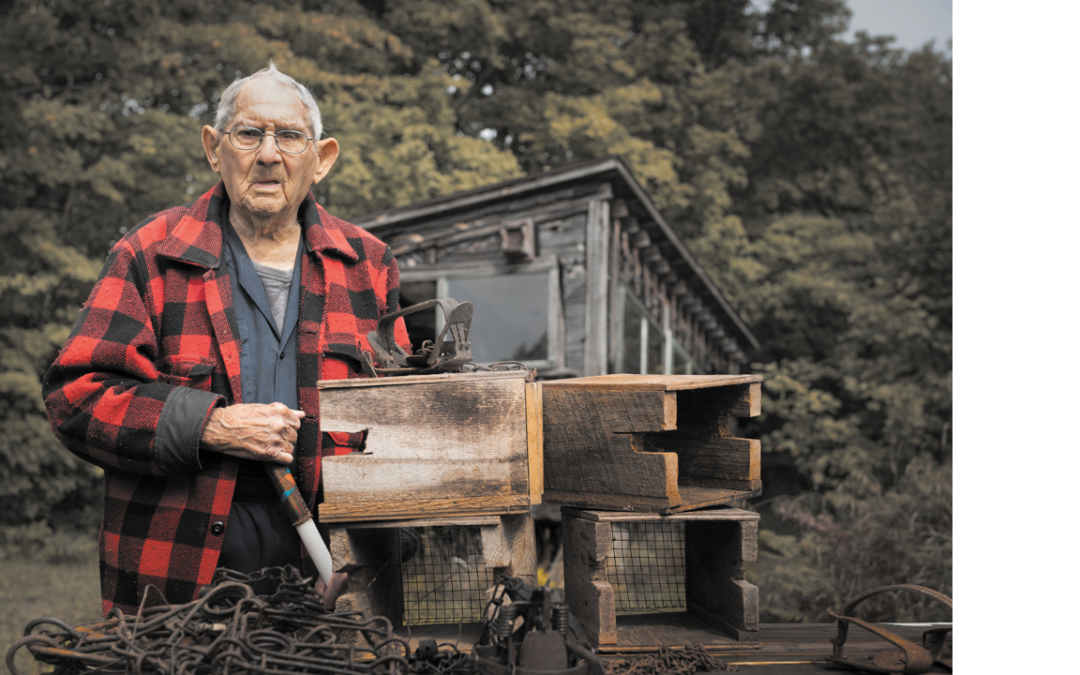
Photo courtsey of Bill Savage
By Jennifer Champagne
Managing Editor
‘He doesn’t let anything stop him’
When 100-year-old Ed Gage was asked if he wanted a subscription to The Munising Beacon, he didn’t miss a beat.
“Do I get it free for being a hundred?” he asked.How could we say no?
So begins our Centenarian Club — The Beacon’s new honorary group of free lifetime subscribers, celebrating locals who have lived a century or more of Alger County life.
Meet our first three members — author, woodworker and avid trapper Ed Gage; the city-building force that is Eileen St. Amour; and our oldest member, retired nurse Pat Nybeck.
Pat Nybeck, 103: Pat’s life spans from farm roots in Gogebic County to a long nursing career in Munising. A 1949 St. Luke’s School of Nursing graduate, she cared for patients at the old Munising Memorial Hospital with the gentle voice many still recall.
Eileen St. Amour, 100: Raised by Joe and Georgiana Pelletier, Eileen grew up in a Munising of mill whistles, curfews and circuses. With her husband, Hank, she helped shape the city, building homes and expanding the family store.
Together they represent more than 300 years of Alger County life. This week we kick off with Ed Gage, a storyteller with a penknife and a pencil, a craftsman at the bench and on the trapline. He may very well be the oldest veteran in Alger County. Can anyone prove otherwise?
Ed Gage, 100 years of grit and good humor
A World War II Navy Seabee, woodworker, trapper and storyteller, Gage has lived a century defined by self-reliance and endurance — and lately, by the family that keeps him going.
“He doesn’t let anything stop him,” said his granddaughter and caretaker, Jodi Hendrickson. “My grandpa is blind as a bat and deaf as a doornail, but he still functions. He’s bossy, but he’s earned that right.”
Born in Flint, Gage grew up in a house where ingenuity mattered more than money. “He was a teenager before his dad ever made $1,000 in a year,” Hendrickson said. “A family of six on under a thousand a year — and they made it work.”
That frugal discipline became a life pattern. He hunted, fished and trapped not as hobbies, but as part of the family’s food plan. “They literally ate everything he trapped,” Hendrickson said. “Porcupine, raccoon, turtle. My grandmother had a recipe for fish head soup.”
Books and newspapers were a constant. “I always remember my grandpa reading his newspaper,” Hendrickson said. “He still does. He has to read it through me, but he was always at his desk with a paper.”
Seabee in the Pacific
When war came, Gage went where he was sent. “I was drafted,” he said. He joined the Seabees — the Navy’s construction battalions that built the docks, runways and huts that kept the war machine moving. He can still clock his service. “Probably in October 1943,” he said of entering the Navy. “Two years and five months and 19 days.”
He served in Hawaii and Saipan before being attached to the 2nd Marine Division for the invasion of Okinawa. “The Kamikaze were bad,” Gage said. “After four or five days, we were sent back to Saipan.” He later returned and was reassigned to his battalion.
The war left its marks and its gallows humor. Aboard ship, his bunk sat beneath an antiaircraft gun. “When that cannon started, it was like a bunch of people up there were sledgehammers pounding on that deck,” he said.
In a rare bright moment, he found his brother. “I walked up, and my brother was outside a tent shaving,” Gage said. “I threw a stone and hit him.”
He arrived carrying cans of turkey and ham with sweet potatoes — a small feast in a hard place.
Not every liberty ended in a story- book. Hendrickson laughs telling his stock sea tale: “He went out to get stewed, screwed and tattooed — and all he got was drunk.”
‘I decided I was in love’
Back home, Gage nearly re-enlisted — until a woman named Frances “Kewpie” Donathan changed the plan. “I corresponded with her,” he said. “She was a friend of my sister.” They married after the war.
In a family manuscript he wrote late in life — printed for relatives and not published — Gage puts it plainly: “I was thinking about re-enlisting, but I decided I was in love.”
They raised six children — Michael, Gary, Mickey, Chet, David and Brady — and later adopted four grandchildren. “We ended up with 10 kids altogether,” Gage said.
Kewpie was a force. “My wife was a licensed swimming instructor,” Gage said. “She was busy teaching swimming. … After that, she got involved with St. Vincent de Paul. … She wasn’t sitting around the house.”
Harry Lindquist, a lifelong friend, said Kewpie shaped a generation. “Kewpie’s personality was top notch,” he said. “She always had time for anybody that had problems or needed to learn something. … She wanted every person to know how to swim.”
Lindquist adds that Kewpie was a powerhouse outdoors. “She was a better shot than he was with a rifle,” he said. “She was a hell of a tracker too.”
Between the Forest Service, plumbing and furnace work, trapping and the odd job, Gage kept moving. The routine was the point.
“He got up every day, got dressed and went to work,” said Teri Gage, one of Gage’s granddaughters turned adopted daughter. “No matter what. He was just built that way.”
At home there were rules — not mean, just practical. Lights off, don’t waste water, put food by for winter. “Waste not, want not,” Teri said. “That Depression mindset never left him.”
There were apple trees the children weren’t allowed to climb. “We couldn’t go in those apple trees,” Hendrickson said. “But I have pictures of my son in them. The great-grandkids are all over in those trees. It’s not fair,” she added, laughing.
His resume reads like a postwar map of the U.P. “Atlas Plywood … then Nelson Coal Company delivering fuel oil and gasoline. … I bought some equipment and went into the heating business … 15 years. … Forest Service, I was there 23 years,” Ed Gage said. “I quit the first of April before I turned 80 years old.”
That might sound like the finish line, but for Gage, the real story starts there. Next week: the hard turn, the comeback and the remaining century of life that followed.
The hardest chapter — and the comeback
Ed Gage’s hardest chapter came in midlife.
“My grandfather was an alcoholic,” Gage’s granddaughter Jodi Hendrickson said. “He drank from the time he got up until he went to bed. He trapped, hunted, worked and still provided, but it was rough.”
A final DUI forced the issue — and Gage asked for help.
“I told my attorney … instead of going to jail, have [the judge] send me to Iron Mountain to the clinic,” Gage said. “I was seven weeks at Iron Mountain. And I never had another drink. … I tried to drink a beer … just couldn’t drink it … so I gave up on it.”
“It’ll be 35 years in December,” Hendrickson said. “It changed the whole family.”
“He doesn’t dwell on it,” granddaughter Teri Gage said. “But that’s when things turned. You could feel the house get calmer.”
Now, when Hendrickson heads out in the evening, Gage offers his stock line: “Drunk drivers go to jail,” he tells her. It’s a joke and a reminder.
The man who didn’t hug much learned to show more tenderness without changing who he is.
“I’ve never heard him say ‘I love you,’” Hendrickson said. “But he shows it. He’ll let you kiss his forehead. He’ll give the quick man-hug. He shakes my son’s hand. That’s his way.”
In old age, the affection is easier to spot.
“We went to see my mom, and he said, ‘How’s my baby daughter?’” she said. “He’s gotten more affectionate.”
Staying in his own house
After Gage’s wife, Kewpie, died in 2018, Hendrickson, other relatives and the Alger County Commission on Aging rotated visits to his house. By 2020, Hendrickson made a promise.
“I told him if he could hang on until my son graduated in 2020, I’d move in,” she said. “I didn’t want him in a nursing home. He’s been in this house since 1953.”
Purpose and routine carried him through another scare — two heart attacks at 96.
“He recovered,” Hendrickson said. “I take him trapping. We go fishing. He has something to look forward to every week.”
Even without eyesight, Gage insists on reading and road time.
“We read to him every night,” Hendrickson said. “Right now it’s a Kipling collection, and it’s horrible — but he loves it.”
Then there are the rides.
“We hit the back roads in my truck,” she said. “He can’t see, but he knows exactly where he is. He’ll say, ‘Turn left up here,’ and he’s right.”
Gage can’t set traps anymore, but he still runs the line from the passenger seat.
“He tells us where to set and what we’ll catch,” Hendrickson said. “He’s very bossy.”
Lifelong friend Harry Lindquist smiles at the through-line.
“All his life that I’ve known Ed, he’s always encouraged people to trap,” he said. “He’d give people traps, bring Fur-Fish-Game magazines to the library for kids.”
For years, the fur checks helped feed a big family.
“Trapping was the best part of his life,” Lindquist said. “He still gets excited about an otter.”
The soft discipline of 100
It’s tempting to turn a centenarian into a bumper sticker. Gage won’t let you.
“He’s lived 100 years by doing what needed to be done to sustain life,” Teri Gage said. “It’s that simple.”
Hendrickson sees it the same way.
“He taught me how to trap as an adult,” she said. “I hunted with him as a kid, and now I get to go back and do it again. It’s a gift.”
The gift runs both ways. Her son, now serving in the military, burned five days of leave to drive from New York for Gage’s 100th birthday. Family flew in from as far as Alaska and Georgia.
Ask Gage for the big lesson and he shrugs.
“I don’t think there was anything extraordinary about my life,” he said. Then the old timing returns. “I didn’t die. I just keep getting older.”
Having something to live for still matters. Keep moving. Do the work. Don’t waste. Read. Laugh. Take the back road. Turn left when you know the turn is there, even if you can’t see it.