
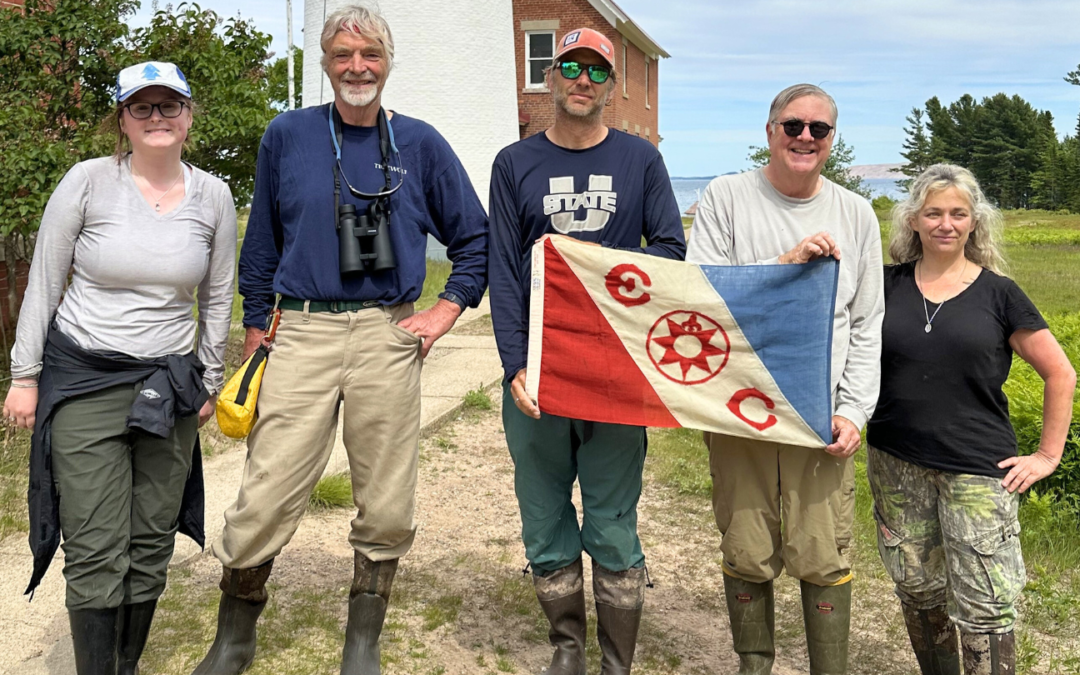
Photo courtesy of William Bowerman
Long road to recovery
By Joshua Grove
Beacon Correspondent
Empty nests and vacant territories signal an uncertain road to recovery for Michigan’s bald eagle population. Four years ago, a highly pathogenic strain of avian flu spread across the country, claiming an estimated 40% of the state’s breeding pairs.
Today, researchers are still sifting through the data to determine the long-term fallout of that catastrophic decline.
The strain in question was clade 2.3.4.4b H5N1, an exceptionally virulent form of bird flu that has touched every continent except Australia, and has been in circulation globally in its current form since late 2020.
Dr. William Bowerman, a fifth-generation Munising native, wildlife pathologist and professor at the University of Maryland, said that variant is very deadly to birds.
“It moved along with waterfowl across the world, and you can see it moving across Northern Europe through Iceland and into the U.S. in the fall of 2021,” he said. “In the spring of 2022, the first big die-offs in eagles were found along the southeastern part of the U.S., reported by the University of Georgia. Then we see this die-off.”
The strain quickly spread north, and biologists with the Michigan Department of Natural Resources began receiving an influx of wild bird carcasses from across the state.
“It kind of started along the southeast part of our state,” said Julie Melotti, a wildlife pathologist with the Michigan DNR. “As birds migrated and moved around during the spring, we started to see it pop up other places.”
Melotti said they were starting to see not only waterfowl dying, but also birds that would scavenge or eat sick or dead waterfowl.
“So in some hawks, owls, and then we even started to see it in bald eagles, because bald eagles … are fish-eating birds, but they are also opportunistic,” she said. “They will, if a sick duck is available, take that because it’s easy prey. And so these scavenging species or these higher-level species that were eating these sick waterfowl, were becoming exposed and infected with the virus.”
In the three decades between 1986 and 2017, a total of 1,490 eagle necropsies were recorded in the state. In 2022, over the course of a single year, the Michigan DNR Wildlife Disease Laboratory processed another 222 individuals, with 71 testing positive for avian flu. Historically, infectious diseases accounted for only 6% of mortality.
“If the band recovery rate for eagles is 12.5%, these are the ones that we are seeing again,” Bowerman said. “You take that rate as our estimate, and you take the 222, that would lead you to believe there are 2,300 to 2,500 dead eagles in the state of Michigan.”
Bowerman is the lead researcher for the Michigan Bald Eagle Project, part of a multi-agency effort using statewide census and banding programs that have operated since 1961. His group’s direct observations since that season have confirmed the incredible toll of the virus on areas once flush with eagles.
Recent field work along the southern shore of Lake Superior found few eagles along the coast of Marquette and Alger counties. More troubling was their total disappearance between Pictured Rocks and the mouth of the Tahquamenon River, Bowerman said.
Elsewhere, there were vast areas where there were no adults in the territories, Bowerman said.
“The nest sites were not repaired. … You can see that the nest is repaired and a lot of times they’ve got a sprig of green pine into the nest — we think that’s for parasites to decrease the parasite load,” he said. “There were no alternate nests either. So these territories are just gone.”
Melotti said the outbreak of 2022 was not an isolated event. Rather, the virus may continue to circulate in the wild indefinitely.
“It kind of went on through 2023, and then cases really slowed down,” she said. “And so we thought, well, maybe that’s it? [Maybe] it came through, affected the birds it’s going to affect and then we’re going to be done. But then it came back in late 2024. We started to see cases again as birds were migrating, and it’s really not stopped since. And I think what we’ve determined is that the virus is probably always going to be out there now at some level in wild birds, and it’s going to be out there making birds sick and killing birds.”
The losses aren’t isolated to one species. Other birds such as owls and hawks have seen declines that can’t be adequately quantified, according to Melotti, because there isn’t the robust census data that there is with eagles. If a similar collapse has occurred, it may have been missed.
Aside from a relatively stable mortality rate due to H5N1, a number of other biological factors are stacked against an eagle’s speedy recovery. They take four to five years to reach sexual maturity, are monogamous, tend to nest in the same territory where they were born and lay one to three eggs once per year. This is in contrast to some smaller birds that raise two or three broods of chicks a year.
“Some of these birds that were affected with avian influenza,” Melotti said, “they were just found at the bottom of the nest. They literally fell out of the nest dead. … Some of these birds, the adult birds, fell out of the nest at the time of year that there were probably chicks on the nest. And so, if they lost their parents, now you’re also talking not only the two adult birds, but the two young birds that we don’t have a number for.”
Recovery could take up to 30 years, according to one estimate, predicated largely on the development of herd immunity.
While the decline is bleak, Michigan’s eagles have bounced back before. In 1961, when monitoring efforts began in earnest, there were only 52 breeding pairs in the state. Their numbers had been drastically reduced by the use of the insecticide DDT.
“In 1972, the U.S. EPA — William Ruckelshaus was the administrator — banned DDT and other organochlorine pesticides, and that started taking those chemicals out of the environment,” Bowerman said. “John Matheson, who is a Michigan graduate, who was the forest wildlife biologist on the Chippewa National Forest, came up with a way to keep people away from the nest sites during the most sensitive periods. And those two individuals are really what drove the recovery.
“When I started in 1984, we didn’t know if we would see eagles in the year 2000 because there were still these residual impacts. And what we had not understood was that’s when it started recovering, and then there’s an exponential growth curve from there.”