
By Chris Chabot
Guest Columnist
July 1994, Sault Ste. Marie in Michigan’s Upper Peninsula: It was midnight, and I was in the pilothouse of the Anglian Lady. We were making our way through the Soo Locks, this tight nautical passage being the lone entry into the vast near-oceanlike waters of Lake Superior. The pilothouse lights were off, eerily lit only by its radar instruments.
Captain John Meadows was peering out over the waters and listening to radio chatter between the Soo tower and ships in the vicinity. Surrounded by charts, navigation displays and various handheld microphones hanging from the walls, it reminded me of working at the console of a radio station in the 1970s.
Meadows pointed at a round, black tube sticking up a foot high from the control center, and I peered in. Inside the tube, it looked like an old computer game of Pac-Man with a beam sweeping in a circle, revealing small white squares all over the green screen — ships upbound and downbound in the St. Marys River. Even though some were miles away, I could see the blip of each. Sitting a good two stories above the water, I felt like I was in an air traffic control tower.
I was on my way to one of the most famous shipwrecks in America, the 729-foot-long ore freighter Edmund Fitzgerald. It had sunk 19 years earlier with the loss of its entire crew in one of the worst storms of the century. I was on an expedition to try to find out what had happened.
On Nov. 10, 1975, I was living near Lake Superior when the Edmund Fitzgerald went missing. The ship had left Superior, Wisconsin, fully loaded when it vanished with its entire crew about 17 miles from Whitefish Bay.
In school the next morning, I arrived to hear students discussing it. One of our teachers drew three waves on the chalkboard, put the ship in the middle, broken in half, and turned to the class, saying, “I think it was three giant waves that sank the Edmund Fitzgerald. It couldn’t handle the stress, and those poor men perished.”
The following year, I was driving along Lake Superior when Gordon Lightfoot’s song “The Wreck of the Edmund Fitzgerald” came on the radio. Large dark storm clouds were forming over the lake. They looked like a herd of wild horses racing towards the shore. It made me wonder what the crew of the Fitzgerald was going through when their storm hit. From that moment on, I was hooked and read any article I could get my hands on about the ship. I wanted to know more about its tragic demise.
In the summer of 1992, I decided to drive across the entire Upper Peninsula. I saw Edmund Fitzgerald paintings, mugs and photographs on display in shops. At a stop in Sault Ste. Marie, I spotted a small piece of paper taped to a wall announcing that shipwreck explorer Fred Shannon would be speaking about the final voyage of the ship in one hour. I could not believe the timing.
Fred was a former police officer and scuba diver known for his history of Great Lakes ships and Michigan history. He had been giving lectures for many years on shipwrecks, especially the Edmund Fitzgerald.
In his 90-minute presentation, Fred covered the historic storms on the Great Lakes and that fateful last night that the Fitzgerald disappeared. It was riveting. Afterwards, I introduced myself and told him my idea of writing a screenplay about the ship. He said, “Well, then you’ll need these …” while handing me a large stack of documents.
Over the next year, Fred sent Coast Guard documents and transcripts of interviews with family members and people who were out on Lake Superior the night of the storm, along with numerous videos to give me a feel for life on ships. He had but one suggestion: Honor the sailors and the dangers they forever faced. Fred stressed that people tend to think of the Great Lakes as five big ponds — not sealike masses capable of claiming more than 6,000 ships, many of them disappearing with their crew like the Edmund Fitzgerald.
Late one night in a bookstore, I came across a book on Greek tragedies. The first chapter explained what I was looking for: man against nature, where man loses due to their own character traits that, while at one time helpful, proved all but useless in the face of this unprecedented danger.
Such was the case with the Edmund Fitzgerald. Its captain was Ernest McSorley, a veteran of more than four decades on the lakes who had lived to tell the tale of the great storm of 1940, which took down two freighters — the Anna Minch and the William Davvock — with all hands.
McSorley had dealt with the gales of November many times. He knew the ways of the lakes but was helpless in fighting this maelstrom with its 100-mile-an-hour winds slamming the ship and waves hitting from every direction as ice was building up on the deck.
This storm was snatching away every tool in McSorley’s arsenal as it knocked out both the Grand Marais and Sault Ste. Marie Coast Guard radars along with the beacon at Whitefish Point to guide them. McSorley radioed that he had a fence rail down, and his own radar was destroyed by the storm. He asked the Arthur M. Anderson to help track him and let him know their location.
Most ominously, he told Captain Jesse Cooper of the Anderson that all his pumps were running, and the ship was listing 15 degrees. Cooper realized that meant with six pumps running, water was probably creeping into the cargo hold. McSorley and his crew were struggling to make their way into Whitefish Bay for safety. They were moving slower and slower on the Anderson’s radar.
The last words from the Edmund Fitzgerald to the Anderson were, “We are holding our own.” Five minutes later, the Fitzgerald disappeared off their radar and out of sight forever.
There was widespread shock when the ship vanished. The Coast Guard was skeptical when the Anderson called in to report that the Fitzgerald was missing and figured its lights were just out.
The storm was so relentless, powerful and overwhelming that the Arthur M. Anderson and the William Clay Ford (under Captain Don Erickson) were the only two vessels willing to go back out and search for the missing Fitzgerald.
Built in 1958, the Edmund Fitzgerald, which was the pride of Columbia Transportation, was for years the largest ship on the lakes. Most sailors wanted to work on it, and it set shipping tonnage records for 10 years in a row. Over the years, the mystery of its disappearance only grew.
In early June of 1994, I received a call from Fred Shannon with astonishing news. Fred had set money aside for building his dream house, but now that money would instead be used to finance an expedition to the Edmund Fitzgerald — and I was invited to come along.
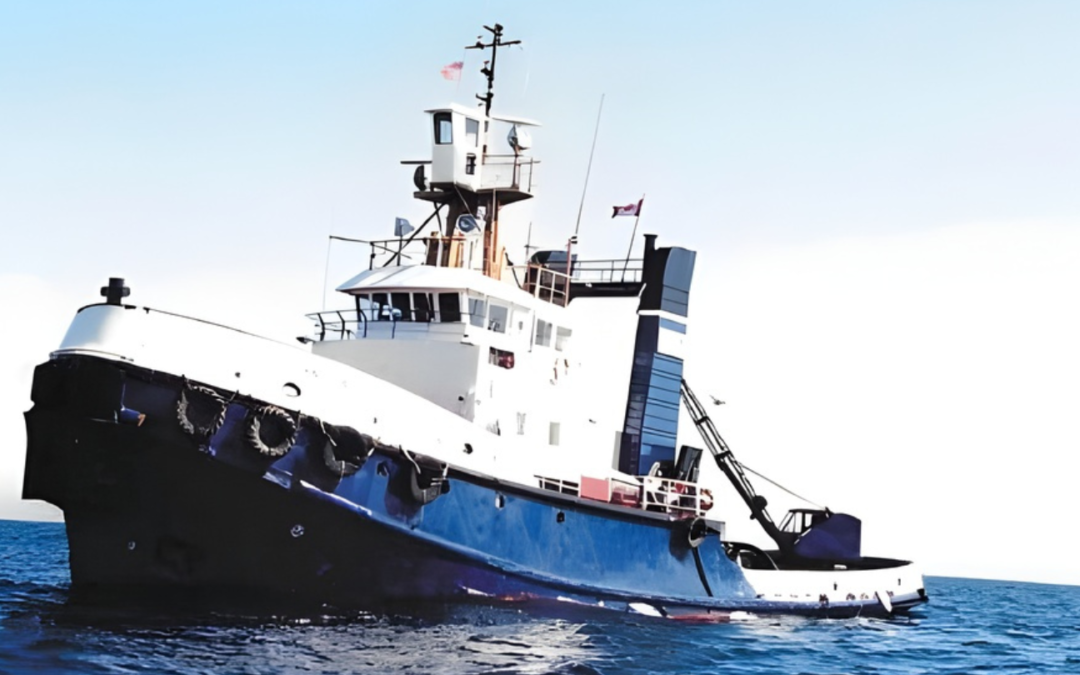
 That July, I arrived in Sault Ste. Marie as the 180-foot Anglian Lady pulled into port. Formerly a British tugboat made for the North Sea and built in 1953, she was reequipped to sail the lakes and was noted for its ability to handle the worst storms.
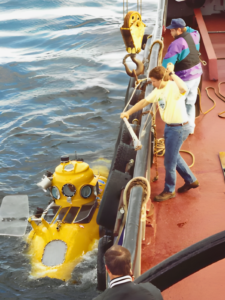
One by one, the people Fred had picked showed up, along with his wife, Betty. This included the Delta submarine and its crew along with the tugboat support team. There was also a photographer, a shipwreck archaeologist and TV reporter Ric Mixter and his cameraman.
That evening, the expedition team gathered in the galley to go over what was known about the sinking. The ship was broken into two parts with the middle part disintegrated. The bow section was right-side up and the stern was upside down about 170 feet away. The ship was laid out at the bottom of the lake in virtually the same position as the Titanic.
In the previous 30 years, three ships had met the same fate: the Daniel Morrell in 1966, the Carl Bradley in 1958 and the Henry Steinbrenner in 1953, but each of those had survivors.
Fred put a small wooden model of the Edmund Fitzgerald on the galley table and showed us drawings and maps that the Coast Guard had done of the ship. He talked about the most accepted theory: that in the end, the ship sank so fast there was no time to grab one of three hand-held microphones Captain Ernest McSorley had to call for help. The ship’s bow had pushed up 24 feet of mud in the impact.
The goal of this expedition was to treat it as a major accident scene and to look for clues while not disturbing anything. Everything would be filmed and analyzed.
Just before midnight, I heard the engines power up and the tug began to move through the St. Marys River. I sat in the pilothouse as we went through the locks. There were so many lights from other ships that it looked like a large city around us.
I went to my bunk with the rumbling sounds of the ship making its way toward Superior and wondered what the next three days held in store. I had only been far out on this lake when I was 10 years old. Superior was quite rough that day, and I was relieved when we had to turn around and go back to the safety of the harbor after only 30 minutes. I hoped the lake would be more cooperative this time around.
At 6 in the morning, I awoke to loud cranking sounds coming from the engine room. I peeked out the porthole which was right next to my bed. Ten feet from it was a small buoy that said “Ed Fitz — 535 feet,” which meant the Edmund Fitzgerald was lying directly below us in 535 feet of water. I could almost reach out and touch the buoy. It sent an incredible chill up my spine.
It was a sunny, cloudless morning, and the lake was smooth as glass. I went up on deck where the sub was being readied, and several reporters were on deck watching.
Fred Shannon was the first to go down. The sub was lowered into the water and floated away a distance before it disappeared below. The rest of the crew sat in silence awaiting his return. This is it, I thought. We were finally starting to investigate a mystery that had captivated us for 19 years. What would we find?
After four long, tense hours, the sub popped back up. Fred stepped out and was noticeably quiet. You could tell the dive had affected him. This was a man who had dreamed of exploring the Fitzgerald for years and now was finally getting to do that from stern to bow.
We sat down in the galley and watched the first videos from the sub’s underwater cameras as it went out on the next trip with the photographer on board. None of us had ever seen more than 20 seconds of underwater views from grainy black-and-white video, and now we were watching close-up views of it.
As the video started rolling, I was reminded of footage from the moon: a lot of mud and craters. Small black dots were scattered about: the taconite pellets. Suddenly, the upside-down stern of the ship came into view. I could hear gasps of amazement as the camera panned over the name “Edmund Fitzgerald, Milwaukee.”
The tug’s engineers were pointing out parts that I would not have known. “Jeez, that’s her radar directional finder all knotted up there on top. She must have taken one hell of a blow.”
When the ship’s pilothouse came into view, I was able to see vivid details of something I had only read about in the casualty reports. I had pictures all over my office wall of the pilothouse while researching the ship, and here it was so close. Fred said when you are in the sub, there are windows on all sides, and you are mere inches from everything as you glide across the ground.
“I swear it feels like you could just reach through the glass and touch everything,” he said. “It’s truly eerie.”
As each dive returned, we would get new footage to view. We were watching footage from the third expedition when Captain John stuck his head in the galley and said, “They found a body!” There was dead silence. We looked at him, thinking that was impossible.
“No, they really found a body,” he stressed. There was a mad scramble to the pilothouse. Fred took over the radio and said, “This is the Anglian Lady to the Delta sub. I understand you found something of significance. Over.” A voice crackled back, “Near the bow. We are coming back. Over.”
A visibly subdued Fred sat in the pilothouse. He finally took a deep breath, looked up, and said, “That is incredible.”
The discovery of a body near the Edmund Fitzgerald’s wreckage came as a complete shock.
None of us expected to come across a body. The ship had been explored by remote camera in 1976 and 1989. Two additional dives, the first by Jacques Cousteau in 1981 and the second by Joe MacGinnis (who had also explored the Titanic) had given no report of any bodies being discovered.
Captain John said he had to notify the authorities in Canada. Someone pointed out that once it was reported to the Coast Guard, it would show up in the daily logs to which the local press had access. It was decided that a statement would be issued when the press came back on board the next day. It would be short and simple, urging sensitivity as to how the discovery should be handled. For 19 years, the story had been that no bodies had been found. That would never be true again.
Only Fred, the operator of the sub, and the shipwreck archaeologist viewed footage of the body. All three felt that the fewer people viewing the body, the better.
We all gathered in the galley that evening for the debrief of Day 1. Fred began with his dive, seeing loads of taconite pellets scattered about as if the ship had been emptied like a saltshaker; the hatch covers, huge 14,000-pound iron plates twisted into pretzels from the violent collision; and the bow of the ship pushed deep into the mud. He also noted a few undamaged hatch clamps and an open door.
The photographer said he spotted another open door near the stern along with a nautical chart still fastened to a table in the pilothouse. Captain Ernest McSorley would have used that to navigate the lakes. The bow itself had curved like a knuckle from the impact and was split wide open at the bottom. Previous articles had referred to a sweater dangling from the pilothouse. It turned out to be a piece of gray weather tarp.
Finally, the sub operator told us about his dive. They had been maneuvering from the stern to the bow when they spotted the body. At the time, we had only heard of bodies spotted on the Kamloops, which sank in 1927, and the Myron in 1919. Those had been found inside the ship decades later. This one had been found just outside with a life jacket on. We wondered if he had been swept out when the ship sank or if he had tried to open a door as it was foundering.
More dives had been planned, but because of issues with the sub’s battery and the tug charging it, they were able to make only one more dive. Nevertheless, seven dives and 14 hours logged down on the lake floor were felt to have been quite a successful expedition.
That night we had our final evening together. The sub operators all said they had explored Spanish galleons and the Lusitania (sunk by a German U-boat in 1915, during World War I) and had been featured in National Geographic, but this expedition had topped everything. Captain John said he now had to face Monday going back to hauling scrap and old boats. Betty Shannon tearfully thanked everyone for helping her husband’s dream come true.
Finally, the time came to say goodbye. As I drove back across the U.P., everywhere I stopped, the Edmund Fitzgerald was in every conversation I overheard. I spotted newspapers with the story, and my folks said it made all their local and national papers.
As my plane from Marquette rose into the early morning sky to head back to Los Angeles, I could not get over the incredible turn of events that had gotten me involved in this expedition — the fact that I had decided to drive across the Upper Peninsula that summer and that Fred Shannon had happened to be in town to give a lecture just as I arrived.
Shortly after the dive made news, a former crew member contacted Fred and wanted to meet. It was the former cook of 10 years on the Edmund Fitzgerald, Red Burgner. He had missed the last few trips in 1975 because of surgery and was recovering in Texas at the time it sank. I met him a year after the expedition, and he viewed all the footage. He was able to identify every object on the wreck and talk about each crew member. Many of them he had recruited from other ore carriers.
Red admitted to having felt haunted about missing the end of that shipping season. He said he felt some closure getting to watch our footage, and he hoped to see his shipmates again someday. He passed away a few years later, and I like to imagine he got that chance.
Four years after the expedition, I was at the Writers Guild of America Awards show where James Cameron was nominated for Best Original Screenplay for “Titanic.” I was waiting for the show to begin when I realized Cameron was standing near me. A friend pushed me toward him and said, “Tell him your story. You were on an expedition, too!”
He looked at me, and I said, “Mr. Cameron, my name is Chris Chabot.” He quickly said, “The Edmund Fitzgerald. I read about you. I’d like to see footage.” I nearly fell over. Although we spoke for only a few minutes, I was shocked that James Cameron knew who I was.
Soon after, I called Fred, who immediately sent footage of the expedition to him. Cameron later said in an interview that the Fitzgerald was the one ship he wished he had visited.
A production company (Movie Ventures Ltd.) has been trying to finance the project since 1997, so far without success.
Over the decades, there have been numerous theories concerning the final hours of the ship. I spent an evening back in 2003 in Port Huron, Michigan, with five ship captains who were out on the lake on that fateful night in 1975. Captain Donald Erickson of the William Clay Ford laid out what was probably going on in the pilothouse in the final hours with Captain McSorley. Interestingly, each captain had a slightly different theory of what caused the sinking.
Sadly, Fred Shannon passed away in November 2022. He had been looking forward to the 50th anniversary and was still giving talks on the Fitzgerald.
Thankfully in the years since the Fitzgerald fell victim, no ship has been lost on the Great Lakes, but there remains the possibility. Another monster storm may unexpectedly hit the lakes, and people will either miss, ignore or underestimate the warnings at their own peril.
Reverence toward those who sail ships goes back to the Old Testament. Psalm 107 reads, “They that go down to the sea in ships and occupy their business in great waters. These men see the works of the Lord and his wonder in the deep.” For three days I saw up close the struggles, the risks involved and the high price that, sadly, is sometimes paid on shipping in the Great Lakes.