
By Joshua Grove
Beacon Correspondent
Now a backdrop of summer cottages, beachcombers and idle fishing boats, the strip of land enclosing the West Bay in Grand Marais was once a lifeline for sailors fighting their way along the south shore of Lake Superior.
Between 1899 and 1981, crews from the United States Life-Saving Service and its successor, the United States Coast Guard, were stationed at the point to provide emergency assistance to those unable to make Grand Marais Harbor. Their mandate led them beyond the surf and into some of the harshest conditions on the lakes, solidifying a reputation for excellence that persists to this day.
“The Great Lakes were an industrial freeway,” maritime historian Brendon Baillod said. “That really was the engine that powered the Industrial Revolution. It created the Rust Belt. It powered America right after the Civil War; the whole modernization of the United States was really fueled by grain coming out of the plains that was delivered to the Great Lakes, by iron ore coming out of Minnesota and copper coming out of the Keweenaw — and lumber. So [society] grew up around this.”
With the opening of shipping from the north country’s mining ports and forests beginning in the mid-19th century, sailors faced a perilous course along Lake Superior’s newly charted south shore.
Few stretches were as dangerous as the 90 windswept miles between Grand Island and Whitefish Point. Infamous as Superior’s “Shipwreck Coast,” the reefs, cliffs and fast-rolling seas quickly gained notoriety for clawing apart even the strongest vessels of the era.
Grand Marais, then just a seasonal fishing station, represented the only natural harbor along the entire shoreline. To the east lay unbroken wilderness; to the west, the towering slopes of the Grand Sable Dunes. However, a shifting sandbar across the harbor’s mouth rendered it inaccessible to many larger vessels.
The earliest wreck recorded in the area was the Otter, a Northwest Fur Co. schooner lost with all hands in 1829. Over the next half-century, she was joined by the Manhattan, Oriole, Cleveland, W.W. Arnold, Saturn, Oneida Chief, Union, Sumatra and dozens more swallowed by rough seas or broken up at the harbor’s entrance.
Increasingly alarmed by the loss of life and property, federal authorities lobbied to transform Grand Marais into a harbor of refuge. In August 1881, approval came to dredge a channel 500 feet wide and 20 feet deep through the sandy spits enclosing West Bay. Parallel, 700-foot, timber-cribbed piers were constructed to stabilize the channel, and a pile dike was later added to seal off the natural entry to the east.
In 1895, a fog bell tower from Point Iroquois Light Station was transplanted at the end of the west pier and topped with a fixed white light. Below that, a room housing the bell and striking mechanism led out onto a wooden catwalk that followed the pier to shore.
On Dec. 10, 1895, keeper Samuel F. Rogers lit the lantern for the first time.
A Union veteran and lifelong man of the sea, Rogers had little need for worldly comforts. For his quarters, he constructed a rough shanty out of driftwood, equipped with a capped roof and woodstove for warmth. To shelter it from the wind, he erected a fortress-like sand fence cobbled together from salvaged boards and cribbing. It was under those conditions that he performed the duties of his office.
In 1898, a second light was constructed at the foot of the western pier, combining with the first to form a range that pilots could line up to navigate into the channel.
Construction also started on a new United States Life-Saving Service facility on the harbor just west of the rear light, part of an isolated string of posts built to monitor for wrecks where few souls would otherwise witness them.
“It was a beautiful building,” Cathy Egerer of the Grand Marais Historical Society said.
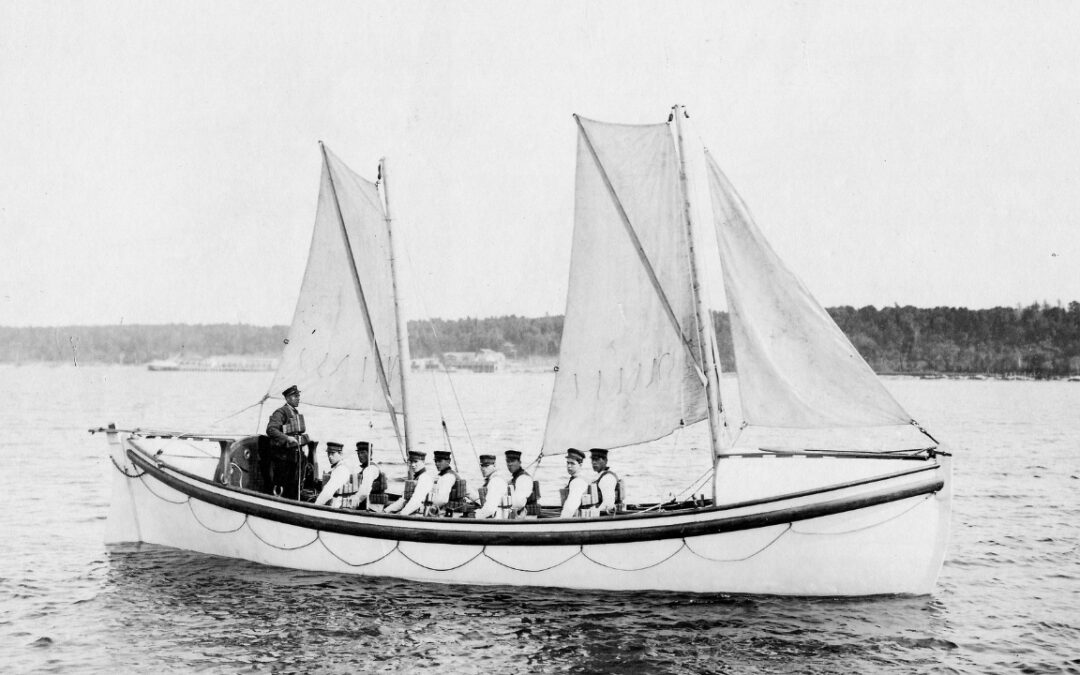
When it opened the following March, according to National Park Service documentation, “the station was considered one of the finest on all of the Great Lakes. The crew included a captain and eight surfmen, two surf boats, a 34-foot self-righting lifeboat and a full complement of beach apparatus.”
Mirroring navigation season, the crew “operated from March 1 through December 31 each year.”
When in operation, Egerer said, surfmen ran regular foot patrols to scan for ships.
“The stations were spaced roughly 20 or so miles apart, and the crew assigned somebody to do beach patrol,” Egerer said. “Every night, they would walk to a point between two stations and exchange a token, and bring it back to the captain as proof of their patrol.”
If a distressed ship was spotted, she said, “the boats would launch into the harbor and then row around, out through the channel to get to the lake.”
On reaching open water, the real work began.
Crews stationed at Coast Guard Point effected numerous rescues over its eight-decade history, safely extracting hundreds of sailors, fishermen and pleasure boaters from the icy grip of Lake Superior.
One of the more notable incidents followed the disabling of the wooden passenger steamer South Shore in 1912.
The ship was piloted by Ora Endress, son of area pioneer and commercial fisherman Emil Endress, and carried passengers, mail and freight to communities between Marquette and Whitefish Point. South Shore bridged the gap left when the Manistique Railway discontinued service to Grand Marais in late 1910.
On Nov. 22, 1912, she was caught in a nor’easter on the return trip from Whitefish Bay. Unable to make the harbor at Grand Marais, South Shore, piloted by Endress, turned into the waves and prepared to ride out the storm at sea. Passengers watched the dim glow of the harbor lights bob in and out of sight, then fade away entirely, as the ship beat ever farther into the gloom of the open water.
About halfway to the Canadian border, wave action began to twist and work the planking apart. Chunks of superstructure tore loose. Water poured in through the damaged upper decks and seams, cascaded inside and extinguished the boilers. Suddenly, Endress and his 14 passengers and crew were left adrift and at the mercy of the lake.
Eight hours later, a beach patrol out of Grand Marais spotted the badly beaten South Shore drifting 10 miles to the northwest, roughly 4 miles offshore of the Grand Sable Dunes. In response, Captain Benjamin Trudell and his men scrambled a gas-powered lifeboat into the still waters of West Bay.
Battered, waterlogged and encased in ice, the ship and its cargo were a total loss, though the surfmen were able to transport all 15 passengers and crew safely back to the harbor. Abandoned, the ship grounded on the west end of the dunes below Au Sable Point, just offshore of the Log Slide.
Seven years later, the lumber barge H.E. Runnels suffered a similar fate as it fought to make Grand Marais.
On Nov. 14, 1919, the Runnels sailed out of the channel toward Au Sable Point, having spent the previous night at anchor waiting for the seas to calm. The captain quickly reversed course, though once the ship reached the end of the west pier, it became apparent that re-entering the harbor was no longer an option. Then, just as the gravity of the situation began to sink in, the driving seas picked the Runnels up and slammed it repeatedly against the breakwater.
The lifesavers’ initial attempts at firing a line from shore failed to connect. A surfboat was launched, followed by a struggle through waves and freezing spray to extricate the 17 sailors trapped aboard the ice-clad barge. In the battle that followed, three surfmen were knocked overboard, and at least one of their mates collapsed from exhaustion.
Four civilians — former South Shore Captain Ora Endress, Ambrose Graham, Joseph Graham and James MacDonald — stepped in to offboard the remaining crewmen, and, thanks to their efforts, everyone involved lived to tell of it.
Nine government personnel and all four civilians received Gold Lifesaving Medals for their roles.
Much had changed in the two decades preceding the rescue. The point’s infrastructure, as well as the body that governed it, had rapidly streamlined and professionalized to meet the demands of the era.
The old driftwood keeper’s quarters was replaced by a modern two-story brick building in June 1908. Technical advancements such as the motorized lifeboat increased efficiency and reduced response times. And, in 1915, the Life-Saving Service and Revenue Cutter Service were merged to form the U.S. Coast Guard.
The station’s mission did not change, though more structural improvements followed the transition.
In 1920, an “officer-in-charge dwelling” was completed northwest of the keeper’s quarters, along with a garage, oilhouse and sidewalks to connect it to the rest of the station. According to a 2020 cultural resource survey of the site, in 1931, a “USCG boathouse and launchway were built on a spit of land pointing into West Bay.” Then, in 1938, plans were finalized for two more buildings.
The cedar-shingled Life-Saving Station remained in use until 1943, at which point, the station house and all of its surrounding outbuildings were burned to the ground to make room for temporary barracks.
Coast Guard planners added to and improved on the site over the next four decades, adapting to serve the coastline and the fast-modernizing fleet that sailed along it.
The station was “decommissioned by the Coast Guard in 1981,” said Hannah Bradburn, visual information specialist at Pictured Rocks National Lakeshore. “By 1982, the National Park Service had entered into a 99-year lease on the Station Dwelling and Officer-in-Charge Dwelling. In 1996, [new legislation] transferred ownership of these buildings, plus the Harbor of Refuge Dwelling, to the National Park Service.”
Ownership of Coast Guard Point is now split between the Park Service, the Army Corps of Engineers and Burt Township.
“Currently, the park utilizes the Station Dwelling and Officer-in-Charge Dwelling as housing for employees,” Bradburn said.
The Park Service also leases the 1908 keeper’s quarters to the township for use as the Grand Marais Lightkeepers Museum, which is open with free admission throughout the summer.
Now, the point is quiet; the surfmen long gone. Their work survives only in memory, a few historic buildings and the bones of vessels on the shores and shallows of Superior’s Shipwreck Coast.