
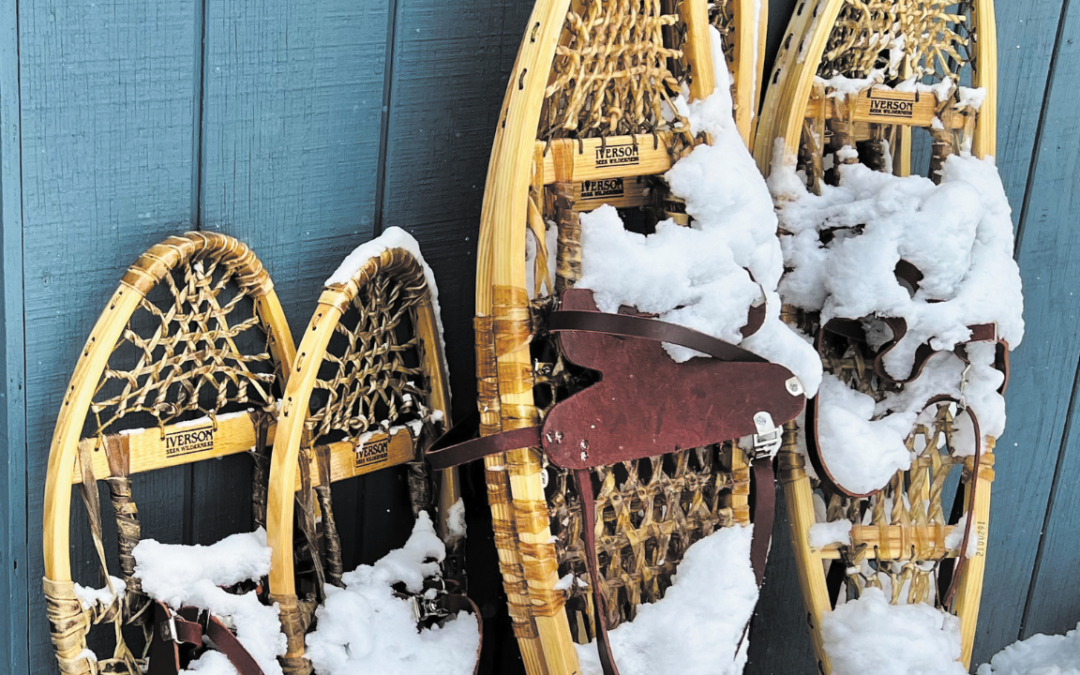
Photo courtesy of Iverson Snowshoes
Longtime Alger firm regroups in Chassell
By Joshua Grove
Beacon Correspondent
In the early 1950s, a transport driver for Shingleton’s Cusino Corrections Prison Work Camp observed crews of inmates as they trekked by snowshoe to project sites in the backcountry of Alger County. In the evenings, he sat down to repair the shoes, studying their shape and the pattern of their lacing, taking notes.
The driver’s name was Clarence Iverson, and through trial and error, he went on to pioneer and sell an improved shoe that was likely based on the traditional “Huron” or “Michigan” pattern developed “by Great Lakes Indigenous communities for our snow conditions,” said Jim Baker, co-owner of Iverson Snowshoes. “It has less of a toe rise, a little wider platform for upland hardwoods.”
Using bent white ash, copper fittings and rawhide lacing, Iverson made a shoe that was faster and more buoyant on the surface of the snow than its competitors.
The Iverson Snowshoe Co. made its debut in 1954. Iverson gradually turned to making snowshoes full-time, and through word of mouth, the company’s clientele grew to include trappers, linemen and conservation officers from Vermont to Alaska.
In the years since, the company has offered at least 17 styles, from the classic Drift Buster, now called the Cross Country, to others with names like the Alaskan, Green Mountain and Tundra, each suited to its own use case and terrain.
Iverson partnered with outdoor suppliers such as the Gladstone-based Marble Arms and clothing retailer L.L. Bean. And the company began offering other products like rawhide laced furniture, fishing nets and metal art set into snowshoe frames.
Iverson’s biggest contribution came early on with the introduction of neoprene lacing.
Adapting neoprene-coated baffling material left over from automotive manufacturing, he was able to create “a synthetic lacing that was more durable and required less maintenance,” Baker said. “And that became what is now the neoprene-laced snowshoe that we make. Clarence was the innovator of neoprene as a [lacing] material.”
In the late 1980s, in failing health, Iverson sold the company to physician Robert Hulse and his wife, Anita. Roughly a year later, Robert died, and ownership passed entirely to her.
Under Anita’s guidance, the company expanded to employ nearly 20 craftspeople from across Alger County, scaling production to an estimated 10,000 to 15,000 pairs a year. It was at the beginning of this period, in 1990, that Julie and Ken Holmes joined Iverson after being introduced to the company by a neighbor.
“We were booming, man,” Julie said. “I’m telling you, we were making a hundred-and-some pairs a day. We had good wood. It bent good. We had our production circle. Everybody knew what they were doing, and we did it.”
Ken milled and bent the frames, while Julie hand-laced them. Together, they spent 37 years with the company.
They remained through 2004, when Anita passed the business to her son, and through 2006, when it appeared Iverson might close for good. When the company returned under new ownership in 2007, Ken and Julie were the only full-time employees left. They remained the backbone of the company’s production when it was acquired by a group of investors nearly a decade later.
Included among that group were the company’s current owners, Jim and Victoria Baker.
“The company was about to go away,” Jim said. “There was a team of us, including people from Munising and from around the Upper Peninsula, who didn’t want that to happen. So we bought the company to keep it from going away.”
Over the next seven years, the group focused on making the company more sustainable, moving it out of its old Shingleton location to a new space in Wetmore. Once there, the Bakers bought out the other partners, and Victoria quit her day job to manage the company full-time.
In spring 2024, the Bakers made the painful decision to move the company out of Alger County.
“Keeping it there would have been awesome,” Victoria said. “But the plain fact is, if we would have, it might not still be here. And I wasn’t willing to take that risk. I was actually the one that went to my husband and said, ‘I think we’re going to have to move.’ …We had plans like maybe in five, seven years that we would possibly do that. But it was certainly not on the table as soon as we did. And so, as it was a shock to everybody, it was actually a shock to myself for making that decision. That was very hard.”
The Bakers started from scratch in their new location, 12 miles south of Houghton, outside the village of Chassell.
“I feel like I’ve moved some things 10 times at this point,” Victoria said. “The one place that’s worked really well is that I created a neoprene lacing area that’s also a showroom. So that space people can come into and walk.”
The new store is open by appointment only. Currently, they employ two Michigan Tech students as part-time lacers and several experienced carpenters on an as-needed basis for cutting frames.
“My plan of attack at this point was to make sure that when we moved, we had our frames and we had our neoprene, which is really our bread and butter because our neoprene is our work snowshoe,” Victoria said. “If you’re working on the line or you’re with the DNR or you’re working in forestry, we have to have that shoe available because people need it for work. So that had to be done before the rawhide.”
They project that rawhide snowshoes should be available again in the fall with the completion of their production room, followed by fishing nets and finally furniture about two years out. For now, products are listed as they become available.
To the Bakers, the effort is worth preserving an Upper Peninsula icon.
“There’s just something about these snowshoes … when people call and talk to me,” Victoria said. “Sometimes I get caught up in conversations where they just sometimes want to call and ask me about a pair of old snowshoes that they have on the wall. They’re not calling to purchase snowshoes. They’re not calling to sell their snowshoes. They just want to know the history and the information about these snowshoes. They were their grandfather’s. They were their father’s. They were their uncle’s. I had a couple come in that had to visit the store because their uncle had such a passion for Iversons. They just wanted to see where they were made. You have the people who want to put them on the wall; they’re beautiful, you have people who are using them. It’s such a variety.”