By Jennifer Champagne
Managing Editor
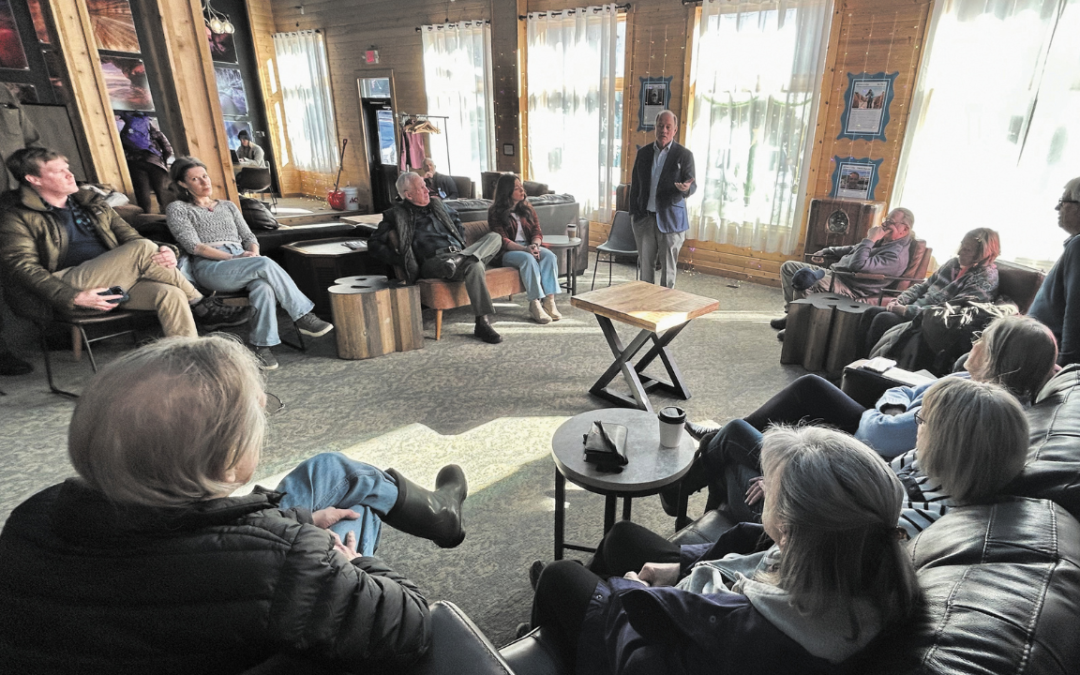
Mike Duggan, the former three-term mayor of Detroit and an independent candidate for Michigan governor, told a small group of Munising-area residents that he is running to break what he described as a “51-49” cycle of partisan control that keeps the state “in Groundhog Day forever.”
Duggan, who left the mayor’s office in January after leading Detroit from bankruptcy-era recovery through years of major investment and redevelopment, has been touring communities in Michigan in a retail-style campaign that relies on small gatherings and repeated return visits.
At the Munising town hall, Duggan opened by pointing to Detroit’s turnaround on public safety and development, then pivoted to Lansing.
“I look at what’s happened in Lansing, and it reminds me of what I saw in Detroit when I first started,” he said.
Duggan repeatedly framed his candidacy as a practical alternative to party-line politics, arguing he can work with whichever party holds legislative power.
“What would happen if somebody ran as an independent and said, ‘I’m not going to get involved in the Republican races, the Democratic Senate races? I’m going to work with whoever’s there,’” he said.
He also cited national party identification numbers as part of his rationale.
“Republican, 27%, all-time low. Democrat, 27%, all-time low. Independent, 45%, all-time high,” Duggan said, attributing the figures to Gallup.
Schools and a sinking fund request that has repeatedly failed
The conversation quickly turned to local education, including Munising Public Schools’ proposed 1.5-mills sinking fund — a property tax levy restricted to building repairs and facility improvements — which has failed multiple times by narrow margins.
Tom Dolaskie, managing director of Deployed Capital, hosted the gathering with his wife, Ana-Marija. The couple have two children enrolled at Mather Elementary School. Dolaskie said Duggan’s recent messaging on schools resonated locally, especially as residents debate another request for school support.
Dolaskie noted the sinking-fund proposal has become a frequent topic of debate on local social media.
Duggan asked how much the request sought and how close the vote had been. When Dolaskie said 1.5-mills and only “two or three votes” separated the outcome, Duggan said tax proposals often hinge on whether voters clearly understand what they will receive.
“If people believe there is value for the money, they’ll open their wallet,” Duggan said. “If they believe they’re putting more money in to get the same product, they won’t.”
Dolaskie said the tension for many residents — including parents — is balancing support for the schools with rising property tax bills.
“Are we just pissing away more money toward taxes?” Dolaskie said, describing the question some voters wrestle with as costs increase.
Duggan tied that frustration to a broader critique of state education funding. Referring to a 1994 statewide sales tax increase tied to school support, he said the state has repeatedly diverted money intended for classrooms.
“Since the Democrats came in, you know what they took this year? $1.3 billion dollars taken out of the schools and put in other things,” he said.
Duggan said he would seek to restore diverted dollars over five years while pushing for consistency in curriculum and accountability.
“Teaching 8-year-olds to read isn’t Republican or Democrat,” he said.
Pressure on teachers
Samantha Meyer, a teacher who previously worked in the Munising school system and now teaches second grade virtually, described classroom challenges she said are playing out well beyond Alger County.
“I have 38 kids in second grade. I don’t know how the hell I’m going to teach them all to read,” Meyer said. “They’re going to get to third grade, and I don’t even know if half of my kids will be able to read.”
Meyer said truancy has become a defining barrier and argued accountability must extend beyond teachers.
“When I have 38 kids in my classroom but only 25 are showing up, when are we going to hold the parents accountable?” she said.
Duggan agreed truancy should be treated as a system problem, not a problem teachers are left to manage alone.
“I don’t care how good a teacher you are,” he said. “They’re not in the classroom.”
Meyer pointed to “count day” pressures, when attendance can affect funding.
“Yesterday, 30 of my 38 kids showed up,” she said. “But then today … I had 21 kids out of 38.”
Teacher recruitment, wages and making the work “rewarding”
Rod Gendron, a semi-retired educator, said one of his core concerns is attracting and retaining talent in education, particularly in small communities where starting wages can make it difficult for educators to build stable lives.
“How do you get people to come to Munising and start working for $30-some thousand with a family?” he said. “It’s impossible.”
Duggan said improving outcomes will require both better pay and better working conditions.
“The way you get talent into education is two things,” Duggan said. “You pay people fairly, and you make the work rewarding. Those two things have to happen.”
Housing, local control and frustration with state regulation
Munising City Commissioner Rod DesJardins said he supports independent candidates but worries Duggan could siphon votes from Democrats and return the state to narrow partisan swings.
“My fear is that you will take enough votes away from the Democratic candidate to put a Republican back in Lansing in the [governor’s seat],” DesJardins said. “We just flip back on that other 51-49 trauma that we’ve dealt with since John Engler. … So, convince me that you can get elected.”
Duggan responded by tying housing pressures across the state to what he said he learned in Detroit’s redevelopment, describing efforts that included building affordable units and using tax breaks tied to long-term rent commitments.
“If it costs you to build an apartment … $1,500 a month, and the people in the community can only afford a thousand, somebody has to pay that $500,” Duggan said.
He argued Michigan lacks a consistent state housing subsidy structure.
“Most states have a fund that helps you fill in that gap,” he said.
Dolaskie later shifted the conversation to “local control,” describing what he called a costly regulatory maze involving water and EGLE requirements tied to a well depth standard he said triggered expensive compliance work at the Brownstone Inn.
“It’s wrong when the state suppresses what these local economies should be able to do autonomously from the state government,” Dolaskie said.
Duggan said he has heard similar complaints across Michigan and shared his own experience dealing with the Michigan Department of Environment, Great Lakes and Energy, commonly known as EGLE.
He described a senior housing complex in Detroit where planned kitchen and bathroom upgrades were delayed for years after regulators determined that soil beneath the property did not meet updated environmental standards.
“I said, ‘I will do whatever you want. Cap it, haul it, just tell me,’” Duggan said.
Instead, he said, the city was required to hire consultants, submit testing plans and wait months for approval — only to be told the initial consultant did not meet state standards.
“It took me three and a half years,” Duggan said, arguing that if the mayor of Detroit faced that level of delay, small business owners have even fewer resources to navigate state regulations.
Duggan said the issue was not environmental protection itself, but inconsistent or unpredictable administration.
He said business owners are not asking for special treatment but want clear, predictable standards so they know what is required.
Duggan said that if elected he would push for more professional, consistent administration and fewer duplicative rules, describing how Detroit eliminated local restaurant regulations that duplicated state codes.
“We didn’t take anything away,” Duggan said. “We just got rid of nonsensical bureaucracy.”
Petition signatures and a return visit
As the meeting wrapped, Duggan described his campaign strategy as intentionally small-scale and community-driven — the same approach he said helped him win in Detroit.
“This is the way I’m running,” Duggan said earlier in the meeting. “Town to town, group to group, whoever wants to come and talk.”
He told attendees he plans to return to Munising and encouraged them to invite others, including skeptics, to future gatherings.
“If you can help us build the crowd for the next, and bring some of your friends and bring the skeptics,” he said.
Duggan said he expects to visit the area multiple times before the election and noted that his message will not shift depending on the audience.
“You’ll see my story doesn’t change when I change audiences,” Duggan said. “I’m going to keep coming back.”
Duggan also asked attendees to help gather petition signatures required for ballot access as an independent candidate.
“I have to file 12,000 signatures,” Duggan said. “I’m going to file 25,000, just to be safe.”
Under Michigan election law, independent candidates for governor must submit at least 12,000 valid signatures to qualify for the ballot. Campaigns typically collect far more than the minimum because some signatures are invalidated during review.
More information about Duggan’s campaign and policy proposals is available at mikeduggan.com.