
Courtesy of Harry Haglund
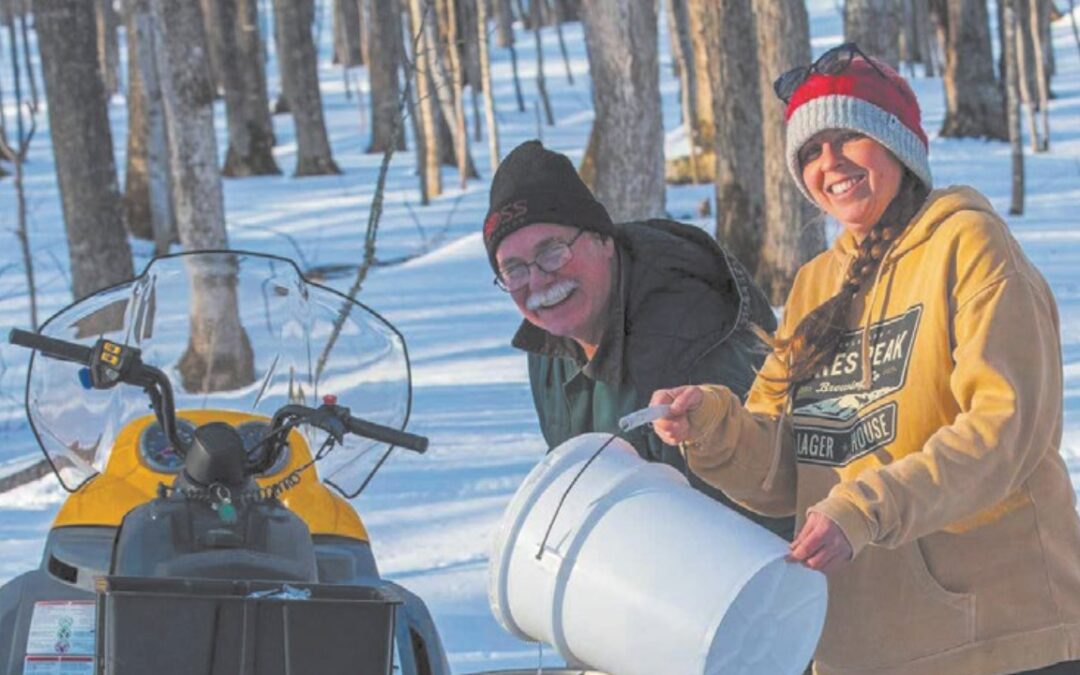
Harry Haglund and McKenzie Guzman Martinez transport sap from trees to a sugar shack.
By Brad Gischia
Beacon Correspondent
This time of year is frustrating for most Upper Peninsula residents. Warm days begin snowmelt and temperatures drop overnight, freezing everything solid again by morning.
For a certain group of people, this is the best time of year. Syrup makers live for the four to six weeks of freeze/thaw that marks a typical spring in the U.P.
Harry Haglund has been making syrup since he was 10 years old.
“It came down from my grandpa,” Haglund said. He was raised in Skandia, but has been tapping trees in Shingleton for almost 40 years.
Todd Masters is making syrup on the same property his grandparents did.
“I bought the house in 2004, but we’ve been tapping trees here since the ’70s,” he said.
Since then, the basic process of making maple syrup hasn’t changed. When the spring thaw starts, the daily temperature swings cause the sap to leave the roots of the tree and head for the canopy to supply energy to the buds for leaf growth. That energy comes in the form of sugar-laden sap.
When you tap a tree, you are literally breaking into that supply line and draining some of the sap, historically collected in buckets hung from the taps, and then again collected and brought to a centralized spot.
Annual syrup makers often build a small shelter called a sugar shack where they can boil the sap for hours until it is reduced to that maple goodness we love to pour onto pancakes or into our coffee.
Both Haglund and Masters are following in the steps of their relatives.
“I have a drill that was my grandpa’s,” Haglund said. “But we’re improving things every year.”
Haglund and company tap about 200 trees a season. Each tree will produce about 10 gallons of sap each year. He can now pump the buckets into a larger tank on his snowmobile so they don’t have to lug five-gallon pails around, and then he can pump it again into the boiler.
That’s 2,000 gallons of sap that must be brought to a boil and kept at a certain temperature, watched carefully to not overboil, and then filtered.
“I do what’s called a ‘batch system,’” Haglund said. “I boil for about 24 hours, maybe about 60 or 70 gallons at a time.”
Haglund said if he boils down 120 gallons of sap, he ends up with about two to two and half gallons of syrup, depending on sugar content.
Masters remembers a lot of time spent around a fire boiling sap with his uncles and grandparents.
“We would start a fire and put a batch of sap in a big flat pan,” Masters said. “It was about 120 to 150 gallons of sap — enough to make three or four gallons of syrup.” Masters said the boil would last for about three days.
Like Haglund, Masters has evolved the technology he uses to make syrup.
“We used to have galvanized pails hanging on the trees,” Masters said. “We tap about 300 trees, and now we have an evaporator and a reverse osmosis system, and lines running to all the trees. We don’t even really have to haul much anymore.”
The sugar shack that Masters’ grandparents built is still in use, but he’s looking to build a new one soon.
Both Masters and Haglund said this year in particular has been rough as far as collecting sap because of the large storms and steady cold temperatures.
“I’m guessing right now that we’ll get one more run, maybe two,” Haglund said. “Once you start getting into the second week of April, it starts staying warm at night and the taps just sort of shut off.”
The other issue is that the nature of the sap changes as the trees begin to bud.
“You end up with what the old-timers called a ‘bud run,’” Haglund said. “The syrup is different. It’s what they used to use to sweeten their coffee.”
Haglund said along with syrup, he makes maple candy, and any leftover sap they don’t have time to boil gets picked up by a local brewery and used in their beer.
Homemade maple syrup could easily go the way of the dodo because of the work required and the very little that people get out of it — far easier to go to the grocery store and buy something with a bunch of corn syrup in it. But Masters said he’s had several people asking him how to get started, looking for pointers.
“It can be a pretty finicky process,” Masters said. “But when you’re just starting out, it’s a lot easier because you’re usually only working with 30 trees or so.”
Making maple syrup is a weather-dependent five weeks of hard work. Then comes a thorough cleaning process, and the shack is shut down for another year.
Neither man has ever sold a bottle.
“I’ve got a few friends with gardens,” Haglund said. “We’ll often trade a jar of pickles for a bottle of syrup, that sort of thing.”
It’s a throwback to the way things used to be, when you could depend on your neighbors to provide what you might not be able to.
“I don’t even eat a lot of syrup,” Masters said. “When you give it to someone who really enjoys it, that makes the whole thing worthwhile.”
Haglund said it’s the process that makes it worth it.
“It may not have been a good year for syrup, but it’s still my favorite time of year,” he said.
After countless hours of work and thousands of gallons of sap, Masters is making the same memories with his family as were made with him as a kid.
“It’s about getting the whole family together to work on it — that’s the best part,” he said.