
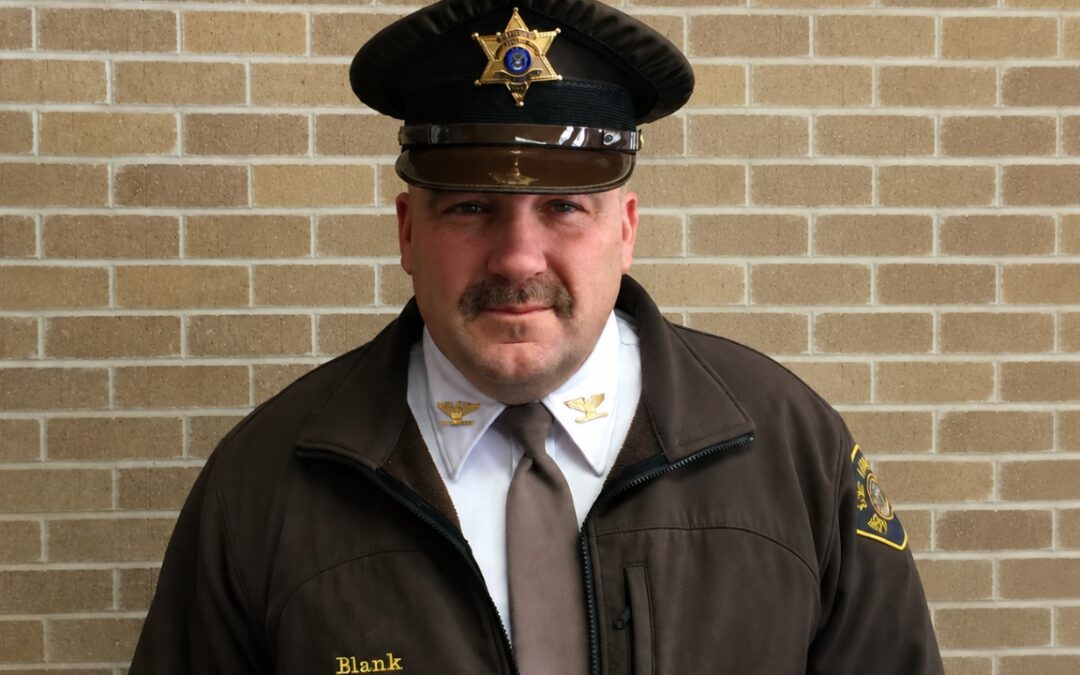
By Jennifer Champagne
Managing Editor
When Steve Blank returned from a recent vacation with his wife, Libby, he brought home a realization that helped confirm a decision years in the making.
For 34 years, no matter where he went, part of his mind remained in Alger County.
The longtime undersheriff could enjoy the sunshine, spend time with family and even squeeze in a little golf, but the responsibilities of the job never fully left him.
“Our vacation was enjoyable, but it wasn’t enjoyable as if I didn’t have to worry about coming back to work,” Blank said. “My mind was there, but a little bit of my mind was still here as well.”
On June 30, that chapter closes.
After more than three decades in law enforcement, Blank is retiring from the Alger County Sheriff’s Office, ending a career that began with a laid-off mill worker looking for something more stable and evolved into one of the most respected law enforcement careers in the county’s modern history.
Blank never envisioned himself becoming the face of the department. In fact, he spent much of his career avoiding the spotlight.
“I never liked being that person in the spotlight,” he said. “I don’t necessarily like talking to TV6 or doing interviews. That’s just me. I’d rather be involved with my guys and make decisions with my guys.”
Yet over the years, he became something more important than a public face. He became a trusted investigator, a mentor, a rescue coordinator, a leader and, to many, the steady hand behind some of the department’s biggest successes.
The journey began far from the sheriff’s office.
A 1986 graduate of Munising High School, Blank attended Northern Michigan University on a football scholarship. After a shoulder injury ended his playing career, he spent a year in Chicago, where his brother worked in the auto body industry, before returning to the Upper Peninsula.
“The city didn’t like me, and I didn’t like it,” Blank said.
He returned home to Munising, worked in area body shops and eventually landed a job at Kimberly-Clark. Like many mill workers at the time, however, he faced seasonal layoffs each winter.
“All I did with one of my friends was ice fish,” he said.
During one of those layoffs, Blank picked up temporary work at the Alger County Sheriff’s Office under then-Sheriff David Cromell. The experience sparked something.
“I started thinking, man, I kind of like law enforcement,” Blank said.
Cromell already knew him well.
“You get to know the family,” Cromell said. “I’d watch him play football and basketball. He wasn’t a stranger from out of town.”
When Blank decided to pursue law enforcement, Cromell helped sponsor him through the police academy while the Sault Ste. Marie Tribe of Chippewa Indians paid his tuition. In 1993, Blank attended the academy in Saginaw alongside two close friends — Todd Brock and Tony Grohovac.
The three traveled back and forth together, graduating and returning to the Upper Peninsula.
“All three of us passed the academy,” Blank said. “I think the U.P. kids were stars down there.”
Blank began his law enforcement career with the Munising Police Department under Chief Doug Miron before eventually transferring to the sheriff’s office, where he would spend the remainder of his career.
His first day remains unforgettable.
“I didn’t even have a gun belt yet,” Blank recalled. “Chief Miron threw me a .38 revolver, threw me the car keys and said, ‘Go patrol.’”
Policing in a small town came with challenges that officers in larger departments rarely faced.
Everybody knew everybody.
The people he stopped on traffic stops, warned at parties or arrested were often people he had known his entire life.
“We all were rabblerousers,” Blank said. “Maybe that’s what makes this job a little easier for me, because I understand that side of people as well.”
That understanding became a hallmark of his career.
Cromell described the young officer as “mild mannered” and said one of Blank’s greatest strengths was his ability to communicate with people.
“He wasn’t arrogant,” Cromell said. “I think he could talk to people.”
Over time, Blank learned one of the most important lessons of rural policing.
“Don’t take things personal,” he said. “Everybody knows everybody.”
That approach earned him trust, both inside and outside the department.
“He’s always been there for me personally as a calm voice of reason,” Alger County Prosecutor Robert Steinhoff said. “He’s there to discuss things in a calm tone, a measured tone, weigh evidence and be that leader in police that we need.”
Steinhoff first met Blank as a child when Blank served as a DARE officer.
“He was the same way he is now,” Steinhoff said. “Professional, calm. I’ve never heard him raise his voice.”
While Blank would eventually become undersheriff, much of his reputation was built as an investigator.
The defining case of his career began in August 2006 when he became the lead investigator in the murder of Juanita Richardson at Pictured Rocks National Lakeshore.
Many officers never investigate a homicide.
Blank spent two years working one.
“That was my most memorable case,” he said. “The hours that you have to put into something like that.”
The investigation stretched across multiple jurisdictions and involved local officers, Michigan State Police detectives, federal investigators and Prosecutor Karen Bahrman.
Blank still credits teamwork for the successful outcome.
“We just worked collectively,” he said. “This is what we’ve got to do, and we did it.”
Brock, now the Alger County sheriff, worked alongside Blank throughout the investigation and much of his career. He said the case showcased Blank’s greatest strength.
“Steve is the most instinctive police officer I’ve ever worked with,” Brock said. “His instincts are second to none.”
Brock and Blank’s friendship stretches back more than four decades. They played sports together, attended the police academy together and eventually served together in leadership at the sheriff’s office.
“I wouldn’t be sitting in this chair right now if it weren’t for Steve Blank,” Brock said.
The homicide investigation ultimately resulted in a conviction, but Blank remains reluctant to take individual credit.
Had Bahrman not been involved, he said, “I don’t know that we would have won that case.”
That tendency to redirect praise toward others appears throughout conversations with those who know Blank best.
Matt Waldron knows it well.
Long before he became a captain in the sheriff’s office, Waldron worked under Blank as a young deputy.
“His investigative skills are second to none,” Waldron said. “The things he’s taught me over the years have been invaluable.”
Waldron said Blank’s leadership style is built on credibility rather than authority.
“He leads by example,” Waldron said. “He’s never afraid to put his boots in the same dirt that everybody else has to.”
That same philosophy shaped one of Blank’s most significant accomplishments: the creation and growth of Rescue 21.
When Brock became sheriff, Blank approached him with an idea.
Alger County had rescue capabilities, but they largely depended on county employees who were often unavailable after long shifts. Blank envisioned a volunteer team built around specialized skills.
“That’s your baby,” Brock recalled telling him. “Take the reins and go.”
Blank started making calls. Mechanics. Electricians. Nurses. Hunters. Pilots. Boat captains. People who knew the woods, the water and the terrain of Alger County.
Nearly everyone said yes.
Today, Rescue 21 has become one of the region’s most respected volunteer rescue organizations.
Dean Seaberg, chairman of the Alger County Board of Commissioners and a longtime Rescue 21 member, credits Blank for building the team into what it is today.
“He’s the heart and soul of it,” Seaberg said. “He’s the backbone of it.”
The equipment evolved alongside the organization.
What once relied on basic snowmobiles and rescue sleds now includes specialized rescue vehicles, marine equipment and a new airboat designed for ice rescue operations.
“A lot of that is thanks to Blank,” Seaberg said.
Deputy Perry King said many of Blank’s contributions happen long after most people have gone home.
“It doesn’t stop when his office door closes and he goes home for the day,” King said. “There are many details behind the scenes that none of us see that he does.”
King described Blank as a father figure within the organization.
“Firm but fair,” King said. “The respect for him is just there.”
As Blank advanced from deputy to detective and eventually to undersheriff, he remained deeply involved in daily operations.
He oversaw jail operations, emergency response planning, rescue programs, investigations and personnel issues.
Yet he never fully stepped away from the people doing the work.
That’s one reason his retirement announcement was met with mixed emotions throughout the department.
“I was sad,” King admitted. “Not going to lie, I was sad. But happy for him.”
There is also a personal side to the story.
Blank and his wife, Libby — his high school sweetheart — have spent decades navigating the demands of a law enforcement career together.
He rarely brought work home.
She rarely asked questions.
Instead, they built a partnership around trust and understanding.
“She’s always been supportive,” Blank said.
Libby describes her husband as dependable, supportive and someone people can always count on.
“He’s just a good, solid person,” she said.
Together they raised two sons who eventually entered law enforcement themselves.
Despite spending a lifetime wearing a badge, Blank never pushed them toward the profession.
“They make me proud,” he said. “I hear about some of the work they’re doing, and they make me proud.”
As retirement approaches, Blank finds himself looking forward to something simple: time. Time to travel. Time to hike. Time to golf. Time to enjoy life with his wife.
“I see her doing all the fun things she’s doing,” Blank said. “And I want to do them.”
The timing feels right. He is healthy. The department is stable. The rescue team is thriving.
“He’s leaving at the top of his game,” Brock said.
Blank doesn’t speak about retirement with sadness. If anything, he speaks about it with gratitude.
“I have no regrets in this position here,” he said.
The only thing he’ll truly miss is the people.
“The conversations with the guys and the employees,” Blank said. “That’s what I’m going to miss the most.”
Even then, nobody expects him to disappear.
Seaberg certainly doesn’t.
“Just because he’s retired doesn’t mean he’ll not answer his phone,” Seaberg said. “That’s just the kind of person he is.”
Blank laughs when people suggest he won’t stop by the sheriff’s office.
He’s heard retirees say that before. Many never return. He’s not convinced he’ll be one of them.
“I see myself stopping in and being nosy and drinking a cup of coffee,” he said.
After 34 years of service, some habits are probably worth keeping.