
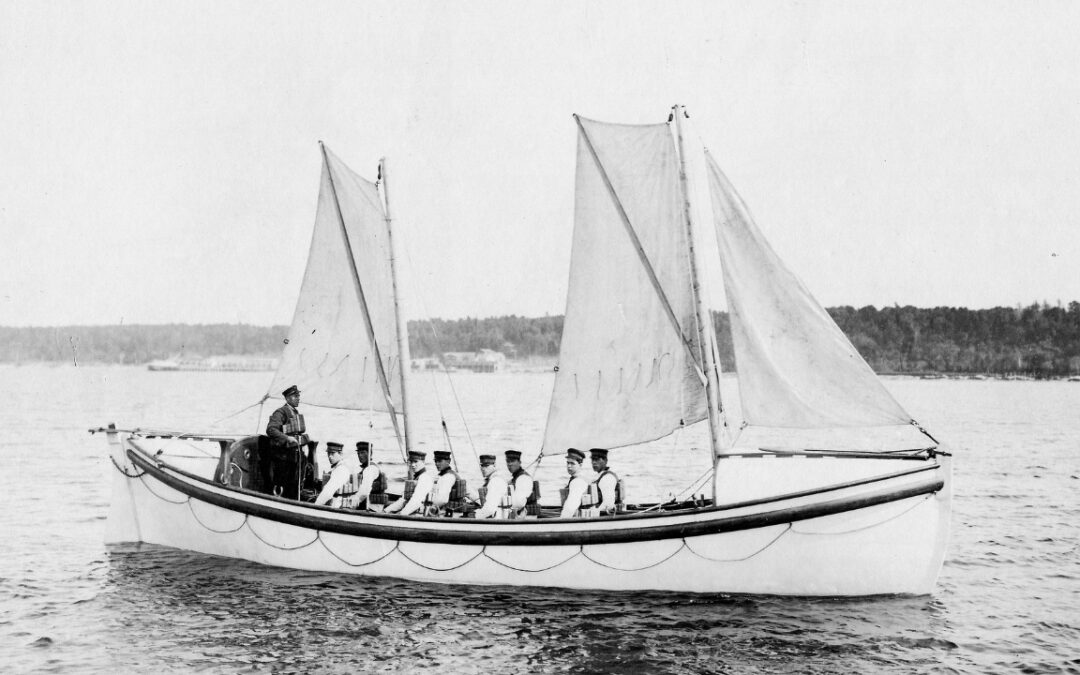
The S.S. Kiowa was carrying a cargo of flaxseed, bound for Chicago, when it sank in Lake Superior on Nov. 30, 1929, about 4.5 miles west of Point Au Sable. (Courtesy of National Park Service)
 By Phyllis Pokela
Alger County Historical Society
The weather was not kind to the Great Lakes shipping industry as it tried to finish the 2025-26 season. Storms with high winds saw many shipping vessels seeking the safety of protected water before cruising once again to finish their scheduled runs.
The Soo Locks at Sault Ste. Marie closed for the season on Jan. 15, and the shipping companies were racing to get their last shipments of iron ore from Lake Superior ports to plants in the southern Great Lakes, assuring them the needed resources for steady production of steel over the winter.
There are several websites that track Great Lakes traffic in real time. A popular one, Boat Nerd, is easy to understand for amateurs like me. Another site is the YouTube “Stream Time Live” of the Soo Locks. Not only do you get a ringside seat to the ships passing through, but there is an active sidebar chat line where well-informed viewers post their ship knowledge letting viewers know what ship is up and center.
There seems to be no lack of “boat-casters” who make it their mission to narrate the scene like it was a Rose Bowl parade, freely throwing the pronoun “she” rather than the ship’s name to describe each one’s berths and girths, cargo capacity, power source and more.
Instant, limitless and sophisticated communication wasn’t always so. A summary of the S.S. Kiowa from the Alger County Historical Society archives tells the story of lives lost, a heroic attempt at rescue and a ship down on Nov. 30, 1929, written by the late Bettey Tomasi and is as follows:
“Lake Superior is notorious for her weather tantrums. One such wild and stormy mood was certainly the scenario on Saturday evening, Nov. 30, 1929. Built in 1920 by the Detroit Shipbuilding Company, the 2,309-ton American vessel S.S. Kiowa, bound for Chicago and carrying 23 crew members and a cargo of flaxseed, did not know this would be her final trip. Having been built only nine years earlier, the steamer was still unable to withstand the awesome power of the gale. S.S. Kiowa foundered approximately 4.5 miles west of Point Au Sable, about 10 miles above Grand Marais. There she stranded. What happened next is a story of true grit.
“Two deer hunters, Charles Chilson and Earl Howay of Saginaw, together with Charles’ father, Richard Chilson of Grand Marais, were preparing to break camp. Charlie apparently noticed the ship’s predicament first and, after semaphoring (signaling) with the crew, he and Earl took a small launch they had brought up from Grand Marais and went to offer assistance to the 18 remaining crewmen. On reaching the stricken ship, they found that four, including Captain Alex Young, had perished in an aborted attempt to launch a lifeboat. A fifth man, Max Westerberg, wheelsman, was found frozen in the drifting lifeboat some time later.
“Unable to take all 18 crewmen off at once because of the size of the small rescue boat, Charlie and Earl removed First Mate Arthur Cronk, Chief Engineer Oscar Tolleson and Second Engineer John Williams and took them to the safety of the Au Sable Point Lighthouse. After several hours of futile efforts to arouse the Coast Guard with fog horn signals, the two lighthouse keepers and the three rescued crewmen manned two available lighthouse boats and accompanied the indomitable duo, Charlie and Earl, back to rescue the remaining men.
“As the rescuers were returning to shore, the Coast Guard finally appeared on the scene, transferring all of the crew except the three earlier rescued who were manning one of the lighthouse boats. The Coast Guard took their charges to Grand Marais to spend Sunday night in the comfort of the Coast Guard Station, while the rescue party returned to Au Sable Point.
“On Monday, the seas had picked up again, making it impractical, if not impossible to launch the boats. But, First Mate Cronk, now officially in charge because of the demise of Captain Young, was determined to reach his men at Grand Marais. He and the ever resolute Charlie Chilson made the six-hour trek on snowshoes. “Mission accomplished! The story of the S.S. Kiowa doesn’t end with the courageous rescues. S.S. Kiowa still had important chapters to write in her story. Fast forward to World War II when her metal was salvaged to be used in that patriotic effort. Then she rested quietly in her 40 food liquid grave until 1968 when she was to make yet another contribution.
“Two young SCUBA divers, Charles E. Nebel, Munising, and Brian Schulze, Crystal Falls, had heard the dramatic tale of S.S. Kiowa and, being at least as intrepid as our two hunter heroes, decided to do a rescue operation of their own. They determined to tackle the titanic task of raising the anchor and two of the enormous bronze/manganese propeller blades. If the raising was a gargantuan task, towing these behemoths back to Grand Marais Harbor was equally as challenging. “Not to be deterred by a nearly impossible undertaking, Nebel and Schulze organized a team of capable enthusiasts who were as determined as they, to see this dream reach fruition.”
Bettey concludes her narrative by saying the success of their mission is manifested in this monument, designed and constructed by Jake Kubiak of Green Bay. It is now being dedicated to pay tribute to the late Judge R.W. Nebel and his wife, Alene. It is also testimony to the bravery of all who have plied the hazardous waters of Lake Superior.
Lake Superior being a temperamental and unpredictable lady was not lost on Bettey. A scuba diving pioneer, she became a PADI (Professional Association of Diving Instructors) master instructor and course director, co-owning Lakeland Sports and Tomasi Tours in Marquette with her husband, George. She authored dive articles, contributed to Encyclopedia Britannica and served on Michigan’s Underwater Salvage Committee.
In 1978, both she and George were awarded PADI’s Distinguished Service Award for their significant contributions to the diving community in the advancement and improvement of diving instruction.
The monument Bettey referred to in her article is the historical marker and community outdoor fountain located at Peoples State Bank on the corner of East Superior Street and Elm Avenue in Munising. The stone fountain incorporates the two propeller blades and anchor razed from the S.S. Kiowa.
Chuck Nebel remembers well the effort to retrieve these artifacts. The S.S. Kiowa was located by Bill Tidd Sr. and Chuck flying over that area of the lake at Au Sable in search of the ship. Coordinates were recorded, and their discovery led to at least eight dives over the summer of 1968 as well as a crew of volunteers and loaned equipment to accomplish the feat. Some of the names mentioned as these assistants were Virgil Wright with his wrecker truck, Burton Masse and John Bjork with their fishing boats, and local diver Mike Booth.
The task of bringing up the anchor and propellers, buried deep in the sand for 39 years, was accomplished by using empty oil barrels and a 250-pound oil drum chained to the 3,700-pound anchor and blades each weighing 2,650 pounds. The barrels were then filled with air using a large pump until enough flotation was achieved and capped underwater to bring the metal pieces to the surface.
The wreck is still a popular spot for scuba divers, and the stone fountain with its sculptured arrangement of anchor and blades have proved to be a focal point downtown. The soothing sound of water and interpretive historic markers provide both a respite and commanding stop to residents and tourists alike.
Since the Michigan Underwater Preserve System was created in 1980 (legislation supported and put together by Michigan sport divers to preserve shipwrecks for later generations), removing artifacts or disturbing the integrity of shipwrecks is now prohibited, and consequences including felony charges are strictly enforced in violation of this law.
The Alger Underwater Preserve, one of the 14 Michigan sites, encompasses an area that stretches from west of Munising past Grand Island and the Pictured Rocks to Au Sable Point. According to the Michigan Underwater Preserves website, there are 15 known shipwrecks in the Alger Preserve; the more popular ones are buoyed for easy location. The Glass Bottom Boat Tours offer a non-diving excursion to view two located in Munising Bay. The company also charters scuba diving tours.
Three shipwrecks can be viewed in shallow waters or partially exposed in the sand by hikers navigating the shoreline between Hurricane Beach and Au Sable Light.
Tomasi passed away in 2025. Her husband, George, survives. It is no coincidence that both Chuck and Mary Nebel received their scuba diving training and certification through the exceptional instruction of the Tomasis. Their retirement from the business left the U.P. with Sault Ste. Marie or Green Bay, Wisconsin, as the closest places to gain scuba certification today.
The Alger County Historical Society is happy to have Bettey and George’s granddaughter Julie Tomasi and her husband, Wil Jakeway, as volunteers for the heritage center. They are fairly recent residents to Alger County, brought here by their employment. We look forward to Wil demonstrating blacksmithing on our grounds this summer.