
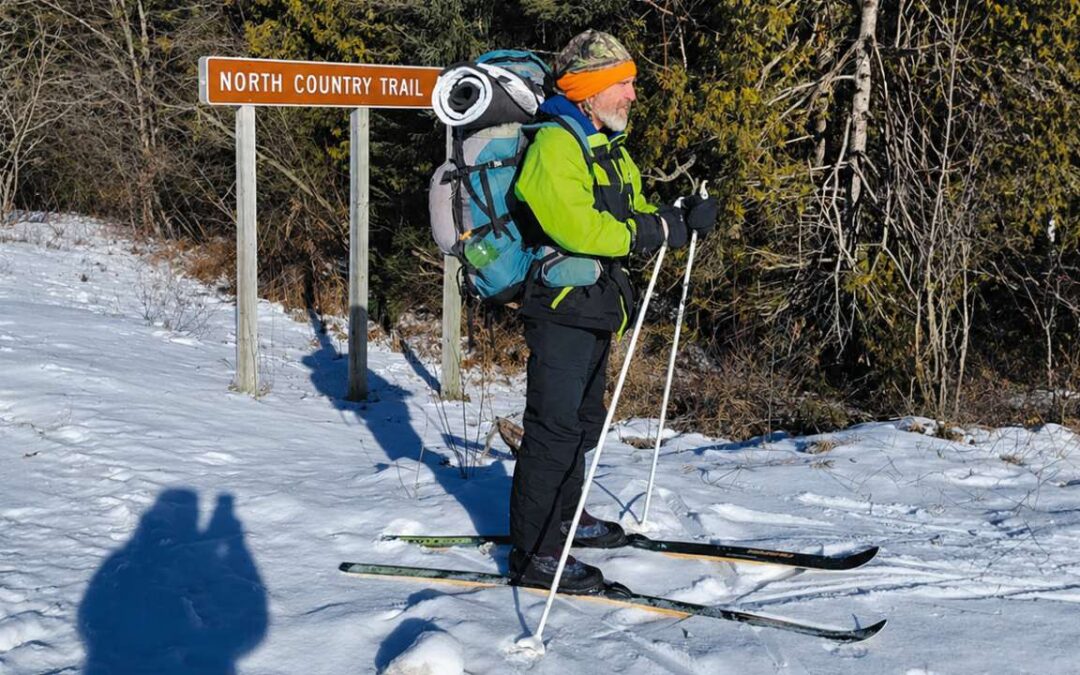
Courtesy of Steven Garner
Steven Garner, a 55-year-old endurance athlete, took 55 days to ski the 555-mile section of the North Country Trail that crosses the Upper Peninsula, from the Mackinac Bridge to the Wisconsin border.
By Melissa Wentarmini
Beacon Correspondent
 By the time Steven Garner reached the end of his 555-mile ski journey through the Upper Peninsula, he was exhausted, exhilarated and exactly where he wanted to be: standing in the wilderness, a little wiser, a little more weathered and with a new story to tell.
For 55 days, the 55-year-old endurance athlete from LeRoy, Michigan, carved his way west across the North Country Trail, a path that hugs the rugged spine of the U.P., from the Mackinac Bridge to the Wisconsin border.
“I wanted new stories,” Garner said in a recent interview in which he reflected on his journey. “All the old ones were getting dusty. This was my 55th trip around the sun, and I wanted to mark it in a way that tested me, that made me feel like I was still becoming who I wanted to be.”
This wasn’t Garner’s first epic journey. At 40, he hiked the Appalachian Trail. At 50, it was the Florida Trail.
But skiing 555 miles through deep snow, bone-chilling cold and wilderness solitude in the dead of winter was something new, even for him.
The notion to ski the North Country Trail took shape over time. A lifelong cross-country skier, Garner has a passion for the sport that began in childhood, sparked by his grandfather, who started a ski lodge in the early 1970s.
A seed was planted when Garner read Joan Young’s book, “North Country Cache,” which painted vivid pictures of the trail’s beauty.
After leaving his job around Thanksgiving last year, Garner saw this unexpected opening of his time as an opportunity. The 555-mile length of the U.P. segment of the North Country Trail seemed more than symbolic.
“It just felt like a sign,” he said. The numerology, paired with the calendar and his birthday, made the idea irresistible.
He was inspired, too, by the contrast between skiing and hiking. He had imagined skiing the flatter expanses of North Dakota, but the U.P. called to him more urgently. It was nearby, known and full of unpredictable terrain.
“It was the kind of challenge I couldn’t resist,” he said.
Garner began his trek on Christmas Day, departing from St. Ignace with a homemade pulk and a $10 pair of skis he had picked up at Goodwill.
Everything about the journey was rough-hewn, improvised and deeply personal. He scrounged gear, built what he couldn’t buy in his Uncle Gary’s shop, feeling his spirit look upon him as he worked, and learned to trust in his own resourcefulness.
But nature didn’t make it easy. Rain washed away the snow only days into the trip, forcing a retreat and delay.
When he resumed on Jan. 8, he did so 20 miles north, near Moran, with enough snow to ski and a heavy pack that had seen better years. From that point on, Garner embraced what he called “forest time,” a slower, more intuitive rhythm dictated by light, weather and instinct.
Each day brought new trials: sticky snow, deep powder, broken bindings and equipment failures. There were nights when temperatures dropped below zero, when his sleeping bag felt more like a coffin and when getting out of it in the morning took everything he had.
His gear froze solid. Tent poles had to be thawed by hand. He burned water over smoky fires and some nights had to resort to eating snow for hydration.
Another night, in deep cold and deeper exhaustion, he hallucinated a dreamscape of interdimensional Vikings and mutants.
There were moments of doubt, of dragging his pulk across slushy gravel or limping down highways with broken bindings.
One morning, he woke to find the zippers of his boots frozen shut. Another night, the sound of splitting trees echoed like gunshots.
He danced in place while cooking breakfast just to keep the frostbite at bay. He wore holes in socks, gloves and gear.
But there were also moments of sublime beauty: a fox darting over snow-covered boulders, an owl hooting above a cedar-lined creek, the haunting calls of distant ravens and the frozen songs of ice-crusted rivers.
One shelter had a trail register dating back to 2013, a jar of old Bustelo coffee and a pill bottle of marijuana, a surreal but oddly fitting collection of offerings from fellow wanderers.
One day, while skiing through a devastated ash forest near a beaver pond, Garner found himself reciting spontaneous poetry about the stumps of virgin white pines, their remnants glistening like ghostly sentinels.
“A ghost forest,” he later wrote. “Once so tall and thick … razed in less time than it takes to grow a healthy branch.”
Initially, Garner aimed to complete the entire 555 miles in a straight, uninterrupted push. But a bout of giardiasis, known colloquially as “beaver fever,” brought him off trail and into a hospital bed, a low point that challenged his resolve.
“I wasn’t happy with myself,” he said. “People were telling me, ‘You’ve done enough,’ but it didn’t feel like the right ending. I didn’t want to quit from the couch.”
He returned to the trail, this time with a shift in mindset: Instead of obsessing over the finish line, he focused on reaching the next resupply, one segment at a time.
“That made all the difference,” he said. “When I let go of the pressure to finish and just focused on the part I was in, the whole trip felt better.”
This approach mirrored a lesson he learned back on the Appalachian Trail: Focus only on the mile you’re in. It’s a technique long-distance runners and endurance athletes often lean on.
“I never told myself I was going to hike the whole Appalachian Trail until I was crossing into Maine,” he said.
Though largely alone, Garner was far from isolated. The trail provided what he called “serendipitous gifts”: a warm chapel on the stormy banks of the Two Hearted River, a pair of gloves that miraculously matched, a trail angel named Michael Sekely who unexpectedly appeared just when Garner needed him most, helping him repair a broken tent.
“Michael was amazing,” Garner said. “He just showed up like he was meant to be there. I didn’t even know how badly I needed help until he offered it.”
Another moment stood out: waking one morning in a survival shelter built by an anonymous soul years before. It was perfectly sized for his tent, protected from wind and snow and equipped with a stone fire circle.
“It was so snug, like something from ‘Survivorman,’ ‘Alone’ or ‘Man vs. Wild,’” Garner wrote.
In one bizarrely perfect moment, Garner plucked a lone glove off a branch in the middle of the remote forest, intending to clean up litter, only to find its matching twin miles later, stuffed in a registration box at a trailhead kiosk, when he needed it most.
“It fulfilled a need I hadn’t even voiced yet,” he said. “It was like the trail provided.”
And then there were the people.
In Munising, a chance encounter with retired ultrarunner Barb Isom and her husband, Charlie, turned into a full-blown trail magic experience — dinner, lodging help and lasting friendship.
“They treated me like a human,” Garner said. “After weeks of solitude, that meant so much.”
Garner reflectively shared one of the most important lessons even nonathletes can take from his journey:
“We live in this world that is so polarized, and we’re told there is so much hate and animosity between people. No one ever asked what church I went to, who I voted for for president, where my parents were born. All they asked was if I was hungry. I just encountered a bunch of people that were willing to help.”
This journey, more than his previous adventures, pushed Garner into a space of vulnerability. There was no backup, no aid station, no warm bed at the end of days filled with exertion and challenge.
When a binding froze shut, he skied an entire day unable to remove his boot. When he fell backward trying to climb over a snow-covered log, he floundered like a turtle on its back, buried and alone.
“You can’t plan for every emergency,” he said. “The randomness of the universe is not something you can pack for. But I always believed that when a decision came, I could make the right one.”
That mindset, he said, was something he hoped to pass down.
“You can’t teach your kid everything,” he said, “but you can teach them how to make good choices. That’s what I tried to do with my daughter.”
Garner sees flexibility, not control, as the key to thriving in chaos.
“Sometimes the plan blinds you to the possibilities right in front of you,” he said. “Letting go of the plan can be the best move you make.”
The physical challenge is only part of it. Garner’s adventures are as much about introspection as exertion.
“There are no screens out there, no distractions. Just long stretches of quiet to arrange your thoughts,” he wrote in his journal. “Most of all, I get stories.”
And stories matter to him.
During the interview, Garner spoke emotionally when recalling the way his grandfather, whom he describes as “the biggest inspiration and hero” in his life, taught him to ski, how his uncle once won a ski trip to Sweden after a race and how his grandmother’s favorite hymn, “Amazing Grace,” had unexpectedly come to his lips one night in that chapel on the trail.
“I’m not even Christian,” he said, “but in that moment I felt close to her memory.”
Each story, each frozen moment, each mile earned in silence and sweat, now lives on in a journal that reads like a personal odyssey.
From falling through river ice to celebrating his birthday alone in the woods, Garner’s journey is equal parts punishing and poetic.
After an already serendipitous adventure, Garner completed his expedition on the vernal equinox, the first day of spring, by climbing Bald Mountain. Before leaving for the U.P. to begin his journey, Garner had camped on a piece of his property named Bald Mountain by his grandfather. This full-circle moment was reflective of the many occasions of kismet that shaped the trip.
Those stories now form a rich new chapter in a life marked by endurance, accomplishment and the pursuit of meaning.
And while Garner doesn’t plan to stop adventuring anytime soon, he also has no intention of rushing the moments.
“It’s about being where you are,” he said. “If I’m skiing or hiking or sitting by a fire in the woods, and it feels like the right place to be, then that’s enough.”
He’s already thinking about what comes next.
“I’ve got buckets full of dreams,” he said, “maybe more dreams than I could ever accomplish in my life. But when the time presents itself, I will just reach into that bucket and hold the one that makes the most sense at that time.”
For now, he’s content to let the stories settle, the muscles heal and the snow melt from his boots.
And somewhere, someone is reading his journal, inspired to imagine her own first step into the wild.