
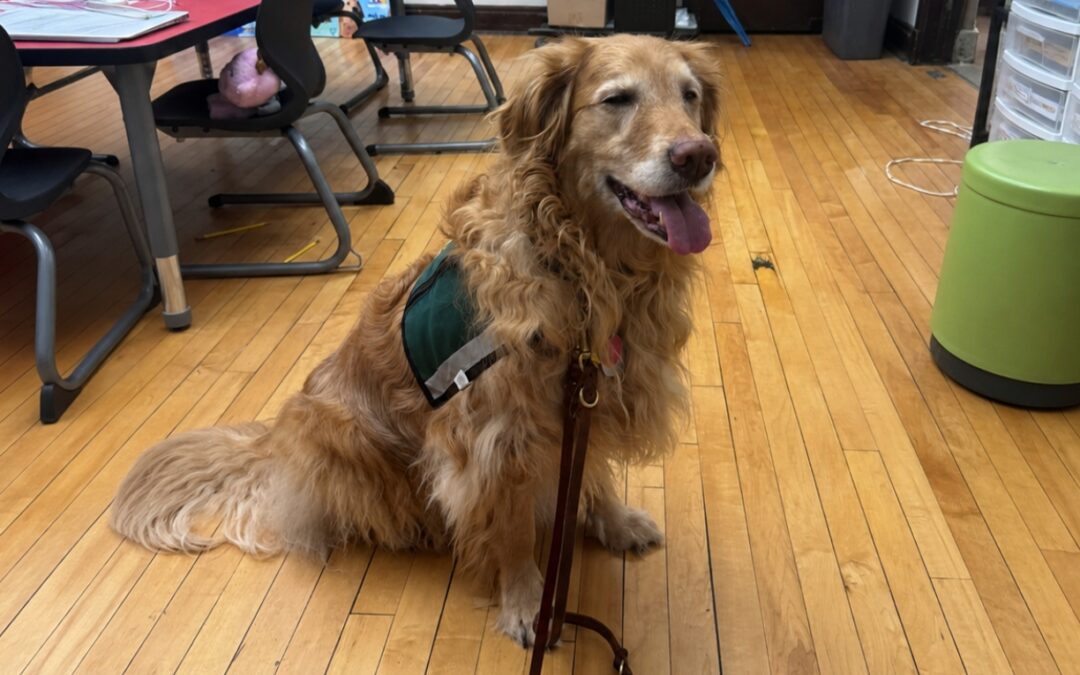
Courtesy of Keena Jones
Madison Jones visited Mather Elementary recently to bring some comfort to students and staff.

Billy Golden | Floof at Large
In high-stress environments ranging from fire departments to schools in crisis, two Upper Peninsula golden retrievers are learning — and in one case already working — to provide comfort where it is needed most.
Madison, a certified HOPE Animal-Assisted Crisis Response, or AACR, dog, and Avalon, a therapy dog in training, are part of a network of canines trained to support individuals experiencing grief, trauma or emotional distress.
As a fellow golden retriever and credentialed floof correspondent, I approached this assignment with professional curiosity and a shared understanding that sometimes the most important work we do involves simply showing up.
For Madison, that work often begins in unfamiliar environments.
“It is really pawsome,” she said of a recent three-day HOPE AACR training workshop in Marquette. “First, I met all the other HOPEfuls: canines and humans.”
Training included exposure to fire departments, where she encountered turnout gear, breathing apparatus and airport security, where she passed through screening alongside her handler.
“The turnout gear with SCBA … was kind of scary,” Madison said. “If you have seen ‘Star Wars,’ they sound like Darth Vader.”
Despite those challenges, she described the environments as welcoming and emphasized the importance of interaction — or, as she framed it, “making new friends.”
Madison’s role centers on emotional support, often in school settings following a crisis. A typical deployment begins before students arrive, with time spent coordinating with staff and preparing a quiet space.
From there, assignments vary.
“We could be assigned with grief counselors, assigned to a classroom or another area,” she said.
Her approach is guided less by instruction and more by instinct.
“I think it is just doggy intuition,” Madison said. “When I walked into a room, I just knew where to sit and who needed some golden love.”
That intuition extends to managing her own limits. She relies on her handler to recognize when she needs breaks, using subtle cues such as disengaging or placing a paw on her handler’s leg.
The work, she noted, can be physically and emotionally demanding.
“You wouldn’t think that being loved on is exhausting,” Madison said. “But I take a part of their grief or stress into my body so they can feel better.”
Avalon, age 2, is still working toward certification but has already completed multiple levels of training and is preparing for the next phase, which includes a trick class to build confidence.
“I get really excited and happy,” Avalon said, describing the moment she sees her vest or harness.
Her long-term goal is to follow a path similar to Madison’s, although the process requires at least a year of therapy dog experience before eligibility for HOPE screening.
Like many young professionals, Avalon brings a different energy to the work.
“Mom says I have two speeds: sleeping and running,” she said.
Despite their different stages of training, both dogs share similar routines and preferences — particularly when it comes to preparing for a day on the job.
Madison and Avalon said their pre-deployment ritual definitely includes “celebratory zoomies.”
Recovery after emotionally intense work also follows familiar patterns.
“Snacks are always high on my list,” Madison said, noting pup cups as a preferred reward.
“Pup cups. Definitely,” Avalon added.
Both dogs also identified favorite treats including bananas and frozen blueberries.
While their work focuses on serious situations, their personalities remain distinct. Madison described herself as “chill, loving and hairy,” while Avalon identified as “energetic, playful and sassy.”
As a reporter — and, importantly, as a golden retriever — I can confirm these are accurate classifications.
Their work reflects a broader role for therapy and crisis response dogs: providing presence without expectation, comfort without conversation.
In environments where words can be difficult, that presence can be enough. And from one professional floof to another, that is work worth taking seriously.